
Reviewed September 2026 by Dr. Jason Hulme DC, DACBSP®, Dip Med Ac
If you broke your ankle, the bone has mended, and you still brace yourself stepping off a curb, that feeling is common and it is not imaginary. Bone union and confidence run on two different tracks. Strength, balance and graded loading through the ankle are usually what close the gap between a fracture that has mended and an ankle a person actually trusts again.
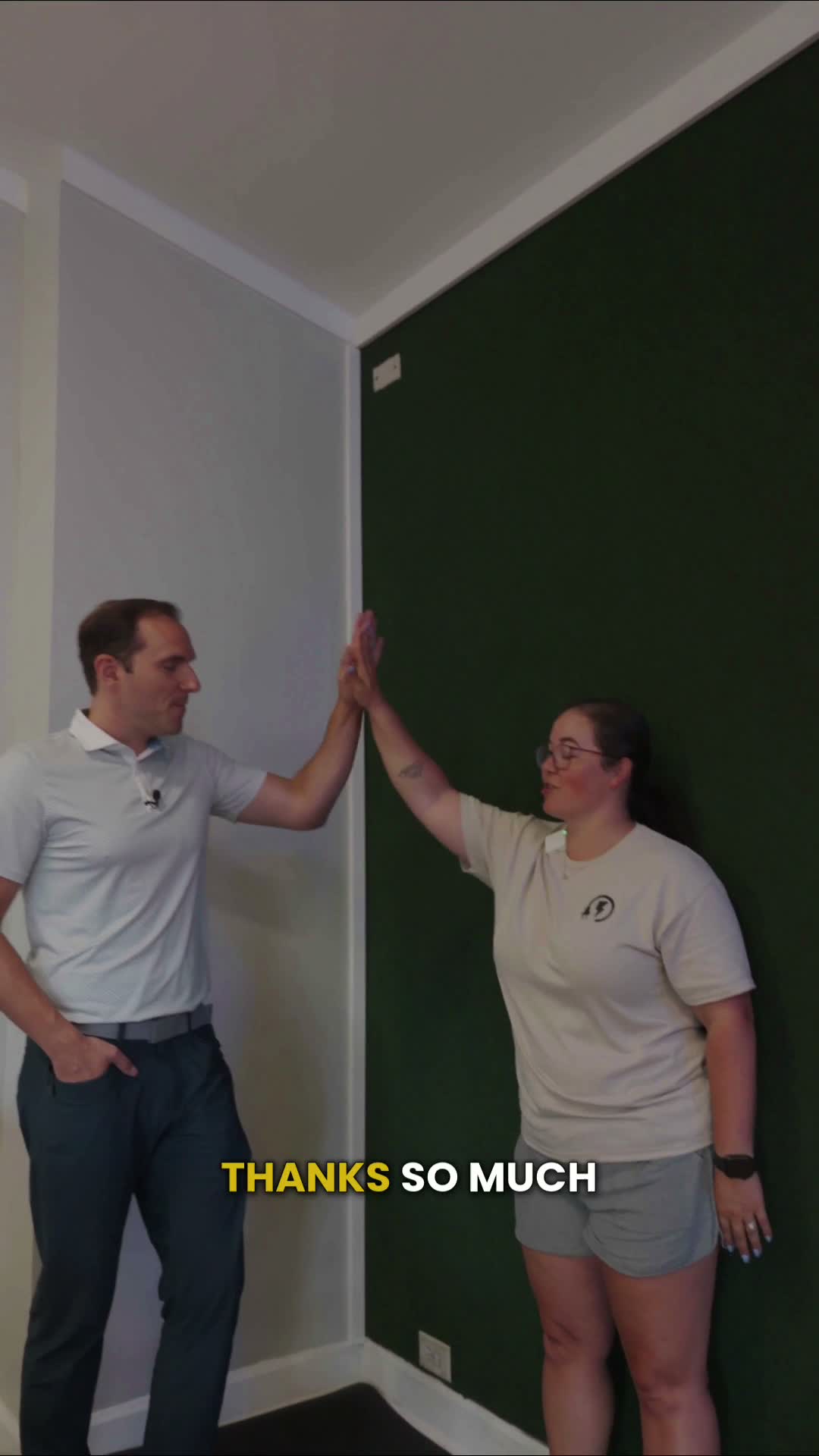
We filmed a moment in the office with Andrea that says it better than we could. She is working through her rehab circuit, and she describes what it feels like to trust her ankle again for the first time in a long time. She can see the path out. This is her account of her own recovery, on her own timeline.
I always felt like I know that the bone is healed and but I still felt like I was gonna break it again.
Why does my ankle still feel unsafe after a fracture?
Because the things that make an ankle feel safe are not the same things that knit a bone back together. Time and protection take care of the bone. Strength, balance and repeated confident loading are what rebuild the sense that the joint will hold.
When you break an ankle you usually spend weeks in a boot or a cast, off that leg or on it very carefully. The calf gets smaller. The small balance reflexes that catch you when a foot lands on an uneven surface get slow, because they have not been asked to do anything. Proprioception, which is your body’s sense of where a joint is and what it is doing without looking at it, dulls with disuse. So when the boot comes off, the bone may be solid while everything around it is still behaving like an injured limb.
| What the imaging tells you | What confidence needs |
|---|---|
| The fracture line has filled in | Calf and lower leg strength back under load |
| The bone is stable to weight bear | Single-leg balance that holds on uneven ground |
| You are cleared to progress | Repeated reps where nothing bad happens |
What was Andrea actually doing in that clip?
She was working through a circuit at her own pace, with strength and balance in it, and she was choosing how far to push each piece. That autonomy is part of the point.
You can hear it in the exchange. She is asked how she is doing for time, and when she has some, she is invited to work through it the best she can. Nobody is dragging her through a set. The ankle is being asked for a little more than last week, in a place where it is safe to find the edge. Many people find that this is where the fear starts to quiet down: not from reassurance, but from a series of reps where the ankle did the work and nothing went wrong.
How do we build rehab for someone coming out of a fracture?
We start from what the ankle can do today, load it a little past comfortable, and add balance and speed as the strength catches up.
- Restore what the joint can move through, especially getting the shin forward over the foot, which is ankle dorsiflexion.
- Rebuild calf and lower leg strength, since that muscle usually shrinks fastest in a boot.
- Add single-leg balance, then make it harder by changing the surface, the speed or where the eyes are looking.
- Load it in the positions that scared the person: stepping down, turning, pushing off.
- Put it in a circuit they can work through on their own, so progress belongs to them.
Where a case needs it, we will use physical agent modalities and hands on work alongside the exercise, but the loading is what carries the recovery.
Why do we treat trust as part of the job?
Because injuries and fractures can steal your joy from the things you love. Somebody who does not trust a limb starts leaving things out of their week, and that shows up in everything else.
If you are hurting, you cannot exercise, and you cannot live a balanced lifestyle, you will struggle in every other part of your life. One of the most important things about good chiropractic and sports therapy care is giving a patient back their independence, their trust and their security in their own body. We love being creative and nerdy with exercise design and using good technology in the office to treat well. At the end of the day, the patient in front of us is by far the most important thing, and that is why the whole team at Active Sports Therapy in Hendersonville is here.
Key points
- Bone union and confidence in a limb are two separate recoveries.
- Calf strength and balance reflexes fade during time in a boot and have to be retrained.
- Graded loading gives the nervous system evidence that the ankle will hold.
- Letting the patient set the pace of a circuit builds ownership, not just strength.
- Andrea’s progress and her timeline are hers, not a prediction for anyone else.
Frequently asked questions
Why does my ankle feel like it will break again when the x-ray looks fine?
An x-ray shows bone, not strength, balance or nerve feedback. Those fade during immobilization and come back with loading. The feeling often settles as the leg gets stronger and the ankle proves itself under real tasks.
How long does it take to trust an ankle again after a fracture?
It varies a lot with the fracture, the surgery if there was one, and how much strength was lost. Andrea’s timeline was her own. The honest answer is that it is measured by what the leg can do, not by the calendar.
Is it normal for my calf to look smaller on that side?
Yes, that is one of the most common findings after weeks in a boot. Calf strength work is a core part of rehab, and side to side comparison is one of the things we measure.
Should I still be doing balance work if I am walking normally?
Many people walk fine and still catch themselves on uneven ground. Balance and reactive work is often where the last of the guarding lives, so we usually keep it in the plan after walking looks smooth.
If your ankle has mended but you still do not trust it, come in and let us measure what the leg can actually do. We will look at calf strength, ankle motion and balance side to side, and build you a circuit you can work through at your own pace. Book a new patient visit here.
Active Sports Therapy · 123 Stadium Drive, Hendersonville, TN 37075 · 615-537-5520
Sources
- Ardern CL, Taylor NF, Feller JA, Webster KE. A systematic review of the psychological factors associated with returning to sport following injury. British Journal of Sports Medicine, 2013. https://doi.org/10.1136/bjsports-2012-091203
- McKeon PO, Hertel J. Systematic review of postural control and lateral ankle instability, part II: is balance training clinically effective? Journal of Athletic Training, 2008. https://doi.org/10.4085/1062-6050-43.3.305
Transcript of the video
Before after breaking my ankle. I always felt like I know that the bone is healed and but I still felt like I was gonna break it again. Yeah, so it’s yeah, I feel like a sense of security. I love it coming back.
I love it. And that’s the strength in the balance coming back girl. That’s what’s all about love girl. Keep it up one step at a time.
I love it. This is beautiful. So time wise how are you doing? Do you feel you are?
Okay good, if you’ve got some time, I would love for you to work through it the best you can I love the circuit the way laid out all the way through love that so I’ll just do another I love it. Yeah the best you can.
Leave a Reply