
Reviewed September 2026 by Dr. Jason Hulme DC, DACBSP®, Dip Med Ac
An athlete rolls an ankle, the swelling is modest, and the pain sits higher up the leg than usual. The question that follows is rarely medical alone: play through it, or shut it down. The honest answer depends on the grade of the injury, what the exam reproduces, and where the athlete is sitting in their season. There is no single correct route that applies to everybody.
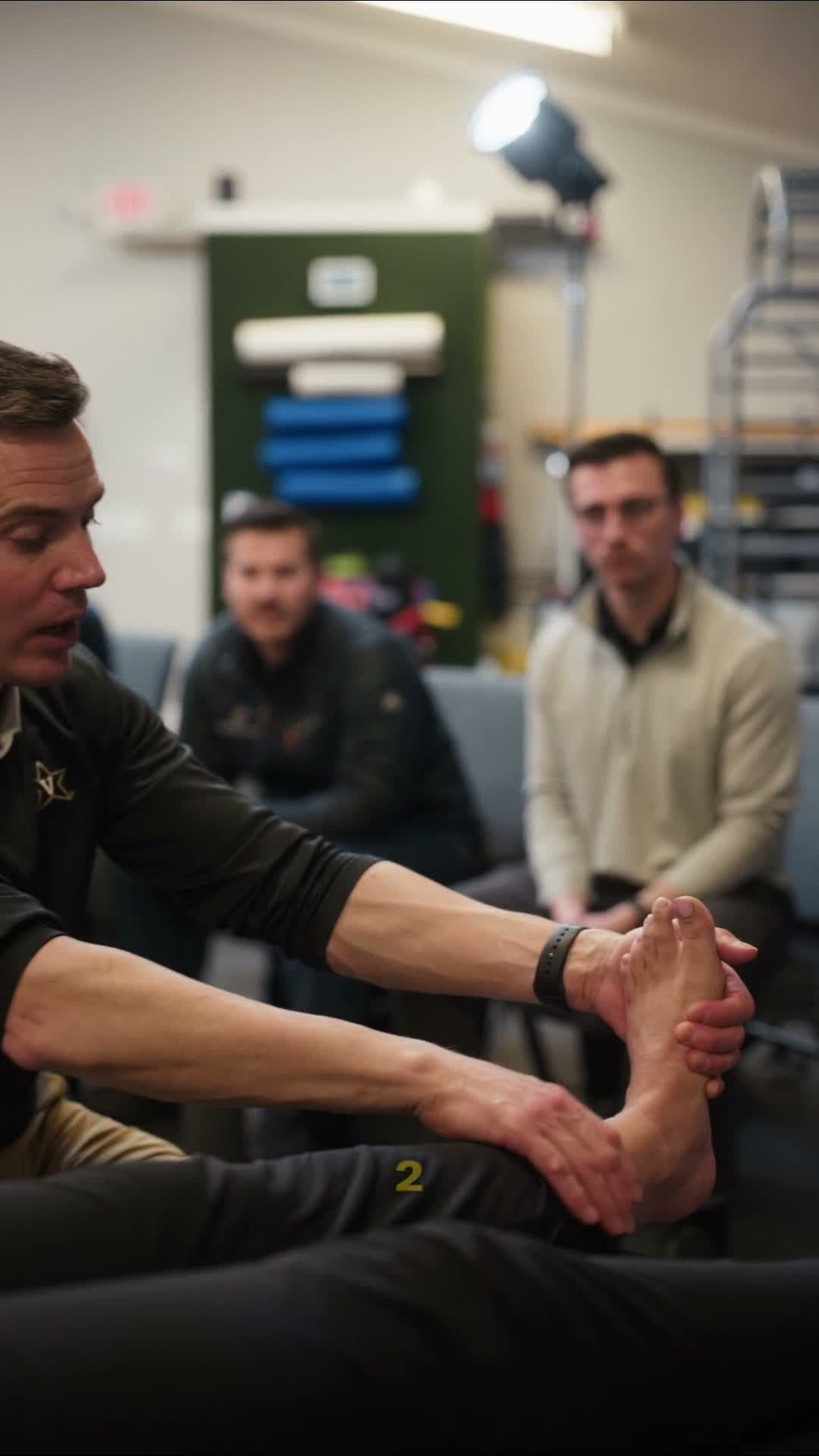
That was the exchange in this clip, recorded at a conference where Dr. Jason and Dr. Jordan were talking through high ankle sprain management with Dr. Nick Strasser, a foot and ankle surgeon at Vanderbilt and Chief of the Foot and Ankle division. The point of the conversation was comparing the orthopedic view of the decision with the conservative rehabilitation view.
Why is there no single right answer for a high ankle sprain?
Because the same tissue injury lands in very different lives. A high ankle sprain is damage to the syndesmosis, the tissue that holds the two lower leg bones together just above the ankle. What it costs an athlete depends on their sport, their position and the calendar.
so I don’t think there’s a right way. I think it depends on where they’re at.
That was Dr. Strasser’s framing, and it is a useful one. Two athletes with a similar looking exam can reasonably end up on different plans.
What does the off season option look like on the orthopedic side?
More runway, so more willingness to quiet the injury down completely. Dr. Strasser described an off season athlete who is dealing with a high ankle sprain as a candidate for a PRP injection with rest and other modalities, to shut things down a little.
PRP is platelet rich plasma, an injection prepared from a person’s own blood. It is performed by the physician managing that side of care. We do not provide injections, and the evidence for PRP in syndesmotic injury specifically remains an area of debate [verify: current evidence for PRP in high ankle sprain before citing any figure]. What matters for this article is the logic Dr. Strasser was applying: when nobody is waiting on the athlete for Friday, you can afford to go slowly and settle the tissue.
What changes when the athlete is in the middle of a season?
The tolerance for downtime shrinks, so the exam has to carry more weight. A low grade injury that stays stable is a different discussion from one that reproduces pain well up the leg.
| Consideration | Off season | In season |
|---|---|---|
| Time available | A long stretch, so settling the tissue fully is realistic | Short turnaround, decisions get made week to week |
| Specialist options discussed | Injection, rest, modalities to calm things down | Grade dependent, with stability the deciding factor |
| Rehabilitation focus | Full rebuild of motion, strength and push off capacity | Protecting the joint while maintaining what can be maintained |
| Risk being weighed | Coming back under prepared | Turning a manageable injury into a longer one |
How does the exam tell you which situation you are in?
By how little force it takes to reproduce pain, and by how high up the leg that pain travels. Dr. Strasser’s sequence was to have the athlete stand on one leg and rotate to load the joint, bring the ankle up to neutral, apply an external rotation stress with the leg stabilized, then squeeze low and work upward.
If pain is still being produced well up the leg, he considers the injury extensive. That finding pushes the conversation toward imaging and a closer look at stability, whatever the calendar says.
What does the rehabilitative side of this look like?
Steady, specific work on the things a syndesmotic injury takes away. At Active Sports Therapy in Hendersonville, we generally see the lower grade ankle sprains first, and that is the population most of this work is built around.
- Restoring ankle motion, especially dorsiflexion, so the athlete is not pushing off through a stiff joint
- Rebuilding calf strength, which fades quickly after any ankle injury
- Hip and single leg control, since rotation over a planted foot is where this injury complains
- Graded loading, from straight line work back toward cutting and pushing off
- Honest tolerance testing before return to sport is on the table
When the exam or the imaging points toward instability, that part belongs to the surgeon. Our job then is preparing the athlete before the procedure and running the rehabilitation afterward.
Key points
- A high ankle sprain involves the syndesmosis, above the ankle joint rather than below the outside bony bump.
- Dr. Strasser’s position was that there is no one right way, it depends on where the athlete is at.
- Off season allows a slower route, including injection and rest, managed by the physician.
- In season, stability and what the exam reproduces drive the decision.
- Assessment and rehabilitative care are what this clinic handles, before and after any procedure.
Frequently asked questions
Can you play through a high ankle sprain?
Some athletes with a low grade, stable injury continue to compete with protection and close monitoring, and others cannot. That call belongs to the clinicians examining the ankle and the people responsible for the athlete, not to a general rule.
Why does a high ankle sprain take longer than a normal ankle sprain?
The syndesmosis is loaded every time the foot pushes off and the leg rotates over it, so it gets stressed constantly during sport. Recovery times vary widely by grade and by person.
Is a PRP injection something you do at the clinic?
No. PRP injections are performed by the physician managing that part of care. Our role is assessment and the rehabilitative work around it.
When should an athlete get imaging?
Usually when the exam reproduces pain with little force, when pain travels well up the leg, or when weight bearing is difficult. The referring physician decides which study is appropriate.
If you rolled an ankle and the ache is sitting above the joint rather than below it, especially if pushing off still feels unreliable, come let us examine it. You can book a visit here, and if the findings call for a specialist we will help get you in front of one.
Active Sports Therapy · 123 Stadium Drive, Hendersonville, TN 37075 · 615-537-5520
Sources
- Sman AD, Hiller CE, Refshauge KM. Diagnostic accuracy of clinical tests for diagnosis of ankle syndesmosis injury: a systematic review. British Journal of Sports Medicine. 2013;47(10):620-628. https://doi.org/10.1136/bjsports-2012-091702
- Williams GN, Allen EJ. Rehabilitation of syndesmotic (high) ankle sprains. Sports Health. 2010;2(6):460-470. https://doi.org/10.1177/1941738110384573
- Nussbaum ED, Hosea TM, Sieler SD, Incremona BR, Kessler DE. Prospective evaluation of syndesmotic ankle sprains without diastasis. American Journal of Sports Medicine. 2001;29(1):31-35. https://doi.org/10.1177/03635465010290011001
Transcript of the video
If they’re off-season and they’re dealing with it and then maybe a PRP in some rest and and some other modalities to try to kind of shut them down a little bit might be a better answer so I don’t think there’s a right way. I think it depends on where they’re at. In the season. Sure doc.
Can we go over Leonard Park, please ma’am. Can we go over this one more time with the high ankles. So yeah when I saw can you show me your test for high ankle sprain again? Because how we were trained was way more aggressive than what I saw you just perform there.
I think you have to get up into neutral. I have to stabilize him here. Sorry. I like totally wrenching on your leg and then pull them out.
Okay, I will have them if they can wait Bear. Yeah love him stand on one leg and rotate got me to try to load it and see if that okay good does anything and then and then bringing I usually bring him up to neutral and then I’ll squeeze and I’ll try to elicit where if they’re having pain up on the leg or two how high up they have pain. So if I squeeze here and then I work my way up and then I get to hear and they’re still having pain. I know it’s a pretty extensive injury.
With Dr. Nick Strasser, foot and ankle surgeon at Vanderbilt and Chief of the Foot and Ankle division. See his practice.
Leave a Reply