
Reviewed September 2026 by Dr. Jason Hulme DC, DACBSP®, Dip Med Ac
Rebuilding strength and mobility after an ankle fracture comes down to two things: letting the swelling resolve fully, and reloading the ankle with exercises set at exactly the right level of difficulty, hard enough to build strength, not so hard that it flares. For most people that means single leg work, some form of support to control the load, and close attention to how many repetitions it actually takes before the muscle fatigues.
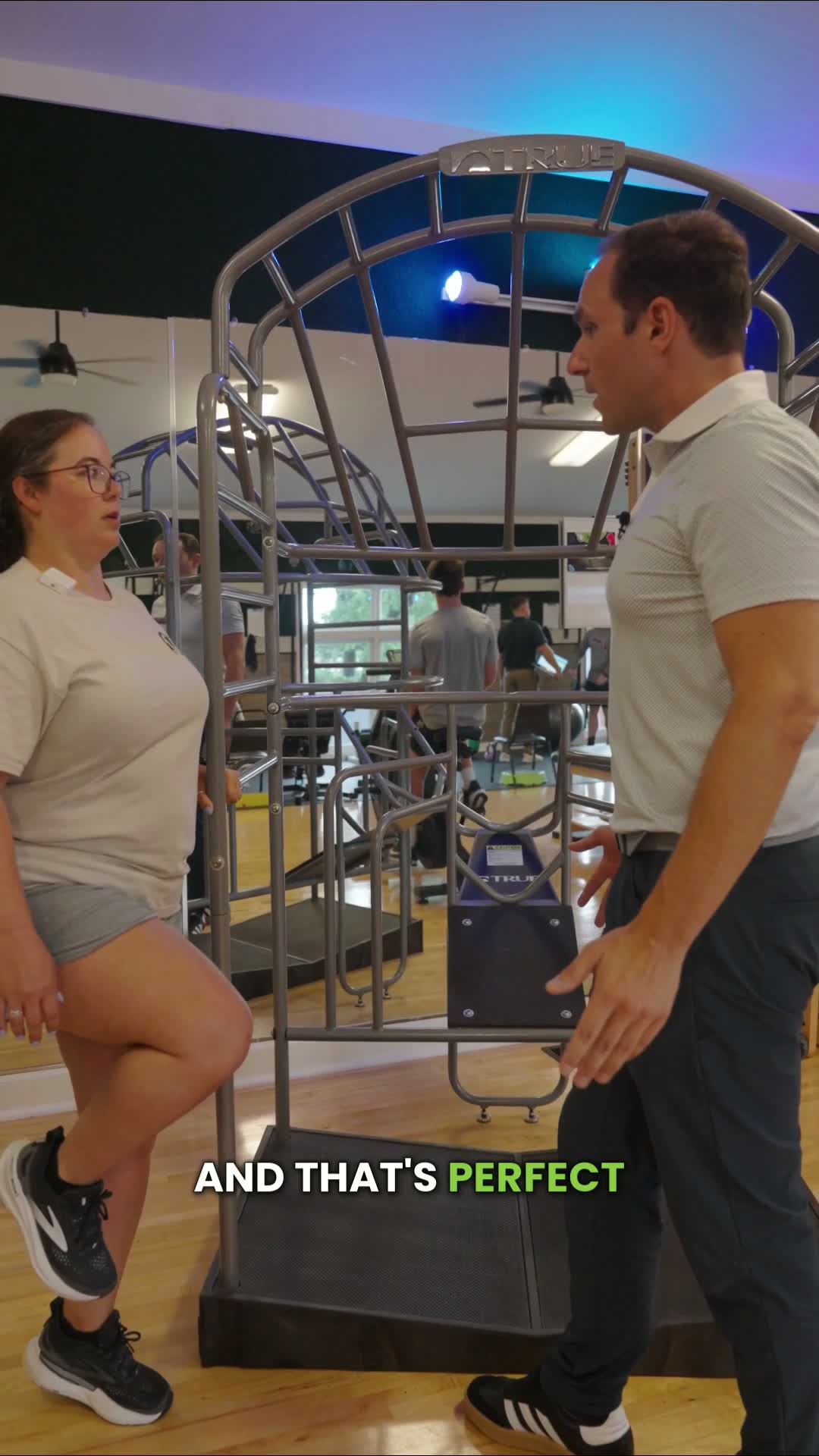
Andrea is a patient of ours at Active Sports Therapy in Hendersonville, a few weeks into rehab after an ankle fracture, and her recent session shows what that looks like in practice. She is doing calf raises, ankle circles and tibialis raises with Dr. Jason, and along the way she noticed two things that told her the recovery was moving in the right direction: she could see her ankle bones again after months of swelling, and she could roll her ankle through a full circle again for the first time since the break.
Why do rehab exercises for an ankle sometimes look too easy?
Because the level of difficulty is being set on purpose, not left at a default. A calf raise trains plantar flexion, the motion of pointing the foot downward and pushing up onto the toes, and it can be loaded a lot of different ways.
Doing a calf raise on two legs is often too easy this far into ankle fracture rehab, it does not challenge the ankle enough to build meaningful strength back. Doing the full movement on one leg alone can be too much too soon, especially while balance is still recovering. Her version splits the difference: single leg, with a hand pressed down for support. That hand pressure reduces how much of her body weight the ankle has to control, so the exercise can be dialed to the level she needs that day.
| Version | What it demands | When we use it |
|---|---|---|
| Two leg calf raise | Modest plantar flexion strength, minimal balance demand | Early rehab, or as a warm up |
| One leg calf raise, hand supported | Full plantar flexion strength with a controlled amount of balance and body weight | Mid rehab, once basic strength and balance have returned but full single leg loading is still too much |
The goal is what we call finding a patient’s edge of ability, the point where an exercise is hard enough that a muscle actually fatigues, usually somewhere past eight repetitions, but not so hard that form breaks down before that happens. That edge moves week to week as strength returns, which is why the exercise a patient does in week three often looks different from week six.
It’s all about just restoring every range back to that ankle.
Why might an ankle start clicking again during recovery?
For some people, a joint that clicks or pops during movement is not new, it is just something their tendons have always done. Her ankles have clicked slightly during ankle circles for years, a leftover from old sports injuries well before this fracture. What changed after the break was that she stopped being able to do the movement at all.
As rehab has progressed, that ankle circle, and the small click that comes with it, has started to come back. For her, that reads as a sign of returning range of motion, not a new problem. A click on its own is not something to read too much into, especially in a joint with a known history of it. What matters more is whether it comes with pain or a change in function, which is something to track through visits, not something to self diagnose from a single session.
How do you know when swelling has actually resolved after a fracture?
One practical sign is whether the bony landmarks around the joint are visible again. After a fracture, swelling can sit around the ankle for weeks, sometimes months, hiding the normal contours of the bone underneath. When that swelling finally goes down, those landmarks reappear.
For Andrea, that took about three months, which is her own timeline and not something we would predict for anyone else’s ankle. Fracture healing and the swelling that comes with it vary by the type of fracture, how it was treated, and the person. Seeing her ankle bones again was worth noting in her chart, but it describes what happened for her, not a schedule to expect.
Why do tibialis raises matter, even though they don’t fix everything?
Tibialis raises, lifting the front of the foot up while the heel stays down, train dorsiflexion, the motion that lifts the foot to clear the ground while walking. They have gotten a lot of attention as a general exercise trend, more than the evidence probably supports for most people.
But after an ankle fracture, there is a real, specific reason to include them. If a patient cannot lift the front of the foot enough to clear the ground with each step, they will catch a toe and stumble. That is not about chasing a trend, it is about restoring one range that walking actually depends on. We include it because it is useful at this stage of recovery, not because it solves everything on its own.
Key points
- Calf raise difficulty is adjusted with body position and hand support, not left at a fixed level.
- The target is a patient’s edge of ability, hard enough to fatigue the muscle, not so hard that form breaks down.
- An ankle click during rehab can be a sign of returning range of motion, especially in a joint with a history of it.
- Swelling resolution timelines are individual and should not be read as a schedule for another person’s recovery.
- Dorsiflexion strength from exercises like tibialis raises helps the foot clear the ground safely while walking.
Frequently asked questions
How long does swelling take to go down after an ankle fracture?
It varies by the type of fracture, the treatment used, and the person. Some people see it resolve in weeks, others take longer. It is worth tracking with your provider rather than comparing to someone else’s timeline.
Is it normal for an ankle to click during recovery?
Often, yes, especially if the joint clicked before the injury. A click on its own, without pain or a change in how the ankle functions, is usually not a concern, but it is worth mentioning at a visit so it can be checked in context.
Why do rehab exercises sometimes look easier or harder than expected?
Because the difficulty is being set for that specific person on that specific day. An exercise that looks too easy for a fit adult may be exactly right for an ankle a few weeks past a fracture.
When can I start calf raises after an ankle fracture?
That depends on how the fracture was treated and when a provider clears the ankle for loading. It should be introduced gradually and adjusted based on how the ankle responds, not on a fixed calendar date.
If your ankle has been fractured and you are working through rehab, or you are not sure whether your current exercises are set at the right level, book a visit with us and we will build a plan around where your ankle actually is right now.
Active Sports Therapy · 123 Stadium Drive, Hendersonville, TN 37075 · 615-537-5520
Sources
- American College of Sports Medicine. “Progression Models in Resistance Training for Healthy Adults.” Medicine & Science in Sports & Exercise, 2002. doi.org/10.1097/00005768-200202000-00027
Transcript of the video
But a full second hold now see what I mean. Yes. Yes and then here. Fantastic same thing.
And if you feel like you can do less hand pressure when you’re on that light do it. Okay, and then if you need more on that one, that’s what you need. This one’s just stability. I love this one is to help.
It doesn’t really help drive and that’s perfect. Okay, it’s all about finding exactly. What’s The Sweet Spot to make you go the fastest and that’s that was money. I love that one a time.
I love that a time. Show me over here. How are you feeling here? On this one.
How are these raises going? How do you feel on the range of that? That looks really good though. That looks really good.
These ones are by far the easy good good. See other. Yeah always had more and I think that’s totally okay. I think the key thing here is just making sure we’re still developing on that front side bringing lots of blood flow there.
It’s all about just restoring every range back to that ankle. And this is doing a beautiful job the way. I know I’m getting ready back to his weird as it is I have like I’m always clicky in my ankles. Both of them.
This one is starting clicking again. Yeah what I mean? Yeah, I’m able to actually rotate it exactly and kind of feel my joint I’m with you and that’s and I can see my ankle bones again exactly as I suppose being so swole for three months.

Leave a Reply