
Reviewed September 2026 by Dr. Jason Hulme DC, DACBSP®, Dip Med Ac
Neck stiffness that shows up the moment you press something overhead is usually a sign of a common compensation, not that something is torn or seriously wrong. Some people use their neck to force their upper back into better alignment, which lets the shoulders get into a better pressing position and lets them press more weight. The problem is that this is expensive on the lower joints of the neck, and once someone is a little seasoned and has some arthritis, it puts the nerve between a rock and a hard place and that technique stops working. It can feel like you just can’t overhead press anymore, but actually what is needed is better technique. Rehabilitative care that restores that motion first, then builds strength into the new range, often helps people move more comfortably overhead again.
Why does an overhead press bring out neck stiffness?
Pressing a weight overhead asks the neck to extend, which just means tipping the head backward, and that is exactly the motion that gets blocked when the upper neck is stiff.
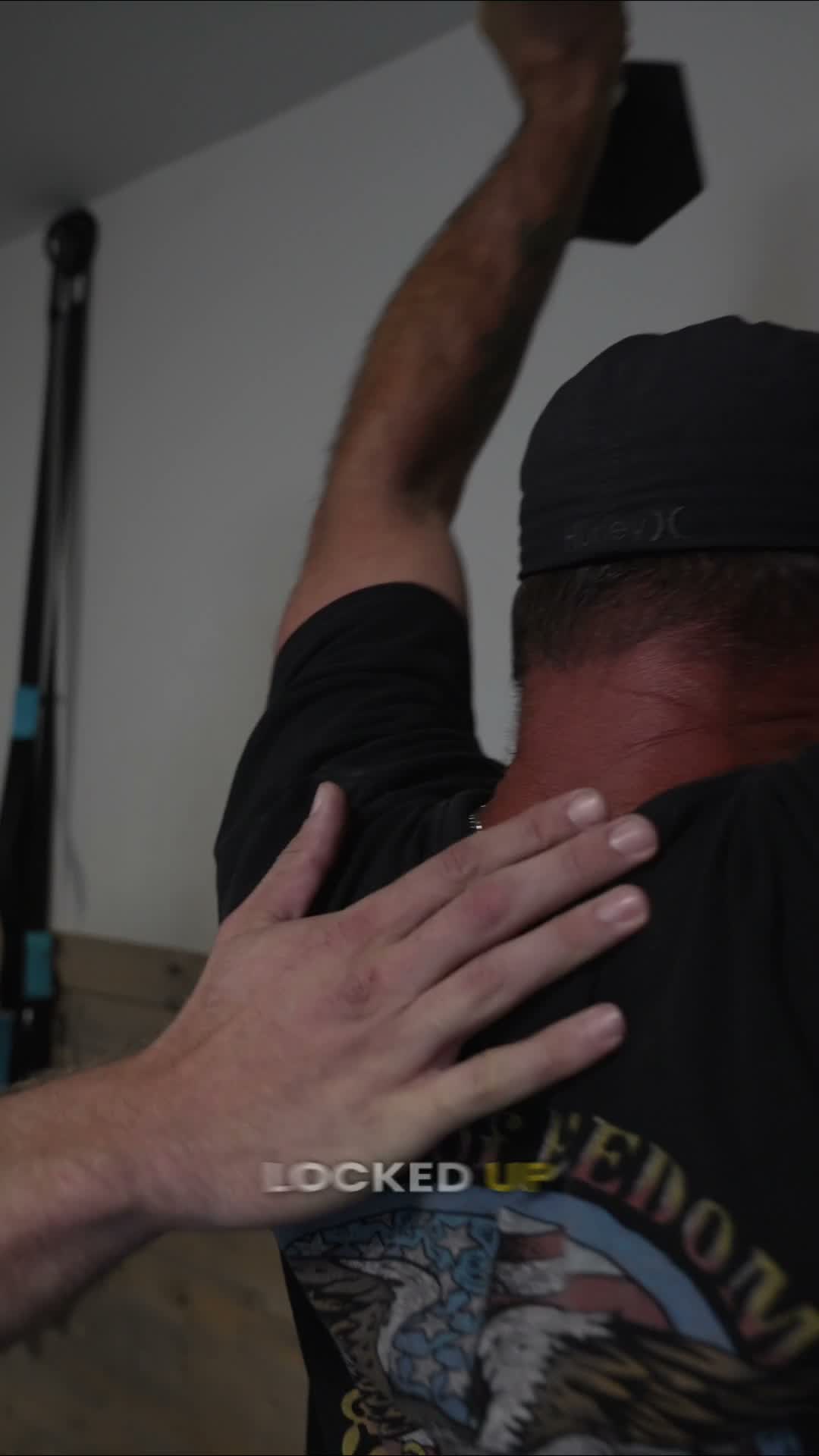
The shoulder can only travel so far before the head has to tip back to let the arm finish the movement. When that upper neck motion is not available, the body finds a workaround somewhere else, usually asking the low neck or the mid back to make up the difference. That is part of what shows up for Rob. Rob had been using his neck to force his upper back into a better pressing position, and every overhead rep tests that pattern directly, which is why it becomes obvious in a gym setting long before it feels like a problem anywhere else.
What does Dr. Joel look for when Rob presses overhead?
Dr. Joel is watching one detail more than anything else, whether Rob’s chin stays down instead of the neck extending to compensate.
That single cue tells him whether the shoulder is doing the work the exercise is supposed to train, or whether the neck is quietly bailing it out. On camera it can look like an ordinary personal training session. In the room, it is a specific correction repeated set after set, until the position holds on its own without a reminder.
Posture is a choice until it isn’t.
Why fix the range of motion before adding strength?
Because strength built on top of a restriction usually just reinforces the restriction, so the joint has to be free to move before it is worth loading.
Our approach at Active Sports Therapy follows the same order for almost every stiff joint we see:
- Restore the range of motion that is missing, working the stiff joint until it moves through more of its normal path.
- Build strength in that new position, so the muscles around the joint learn to control the wider range instead of just the old, limited one.
- Load it under normal training, overhead presses, daily movement, sport, so the gain holds up outside of a rehab session.
What does posture being a choice actually mean for someone like Rob?
It means good posture is not just willpower, it depends on having enough flexibility and strength to hold the position in the first place.
Someone who is relying on the neck to force the upper back into alignment cannot simply decide to stand or press with a better neck position, because the joint will not travel there yet. Once the motion is restored and the surrounding muscles can control it, holding a good position becomes an actual option rather than something the body cannot physically do. That is the idea behind the line Dr. Joel used while coaching Rob through this set.
Key points
- Using the neck to force the upper back into alignment during a press often shows up first as trouble pressing overhead.
- Coaching the chin to stay down during a press is a way to test and retrain that pattern.
- Restoring range of motion before adding strength helps the gain actually hold.
- Alignment and strength work together, neither one alone is usually enough on its own.
- Rob’s care has followed this same sequence, motion first, then strength in the new position.
Frequently asked questions
Why does my neck hurt more when I lift something overhead than at rest?
Overhead movement asks the neck to extend further than most everyday activities do, so a joint restriction that is easy to ignore at rest becomes obvious the moment you reach overhead.
Is neck stiffness during overhead pressing a neck problem or a shoulder problem?
It can be either, and often it is both, because a stiff neck can force the shoulder to work around it. That is why we look at the whole movement, not just the joint that hurts.
How long does it take to get motion back in a stiff neck?
It depends on the person and how long the stiffness has been there, so we do not put a timeline on it. What we can say is that we follow the same approach, restore motion, then build strength, for every case we see.
Do I need surgery to fix neck stiffness like this?
Most neck stiffness like Rob’s is addressed with rehabilitative care, corrective exercise, and movement retraining rather than surgery. If imaging or a specialist evaluation is ever needed, we will let you know.
If overhead movement has been catching on a stiff neck for a while here in Hendersonville, book a new patient visit and we will work out which joints need motion back before we load strength on top of them.
Active Sports Therapy · 123 Stadium Drive, Hendersonville, TN 37075 · 615-537-5520
Sources
- Kay TM, Gross A, Goldsmith CH, et al. Exercises for mechanical neck disorders. Cochrane Database of Systematic Reviews. https://doi.org/10.1002/14651858.CD004250.pub5
- Kebaetse M, McClure P, Pratt NA. Thoracic position effect on shoulder range of motion, strength, and three dimensional scapular kinematics. Archives of Physical Medicine and Rehabilitation. https://pubmed.ncbi.nlm.nih.gov/10488598/
- American Chiropractic Association. Therapeutic exercise and rehabilitative care. https://www.acatoday.org
Transcript of the video
How we feeling on that good easy thing you’ve ever done in the hardest in between in between easiest and hardest. Yeah. So as we’re going through care with with Rob the biggest things are we have to make sure that his chin is staying down and he’s not extending his neck really big because that’s where he’s locked up is right through here. So we’re building all the strength around the area while letting the joints open up and everything.
So everything can do its job like that.
Leave a Reply