
When a kid who has just gotten taller starts limping after practice, growth is usually part of the story. The long bones lengthen first and the muscles and tendons attached to them are slower to catch up, so the attachment points take more pull than they are used to. At the back of the heel that becomes Sever’s disease, and just below the kneecap it becomes Osgood Schlatter. Both are common in young athletes and both are usually manageable while the athlete keeps training in some form.
What does a growth spurt actually do to a tendon?
It stretches the system faster than the soft tissue can adapt to.
Think of a guy wire on a tent pole. The line is snug, the pole is the right height, everything holds. Raise the pole six inches without letting out any line and the wire is suddenly pulling hard at the stake in the ground. In a growing athlete the pole is the bone, the wire is the tendon, and the stake is the growth plate, a soft area of cartilage near the end of a bone where it is still lengthening. Growth plates that take tendon pull are the ones that get irritated.
Why does my kid’s heel hurt after soccer?
Sever’s disease is the usual suspect: soreness at the back of the heel where the Achilles pulls on the heel bone’s growth plate.
It tends to show up in kids still growing, to be worse right after running and jumping, and to feel better with a few easy days before coming right back when practice ramps up again. Squeezing the sides of the heel is often tender. Calf tightness and a sudden jump in training volume are both things we look at, because they change how hard that tendon is pulling. Many kids keep playing through it with their load managed, though that depends on how irritated it is.
Why is there a painful bump under my kid’s kneecap?
Osgood Schlatter is pain, and often a visible tender bump, where the quad tendon attaches to the top of the shin.
Same mechanism, different end of the leg. The quad pulls on that attachment every time the athlete sprints, jumps, or drives out of a squat, and during a fast growth phase it is pulling harder than it used to. Kneeling on it hurts. Stairs and hills often hurt. The bump itself can stay after the soreness settles, which surprises parents, but a bony prominence that no longer hurts is a different problem from one that does.
Why does the low back get involved too?
Because the same mismatch happens up the chain, and because growing kids often lose mobility faster than they lose strength.
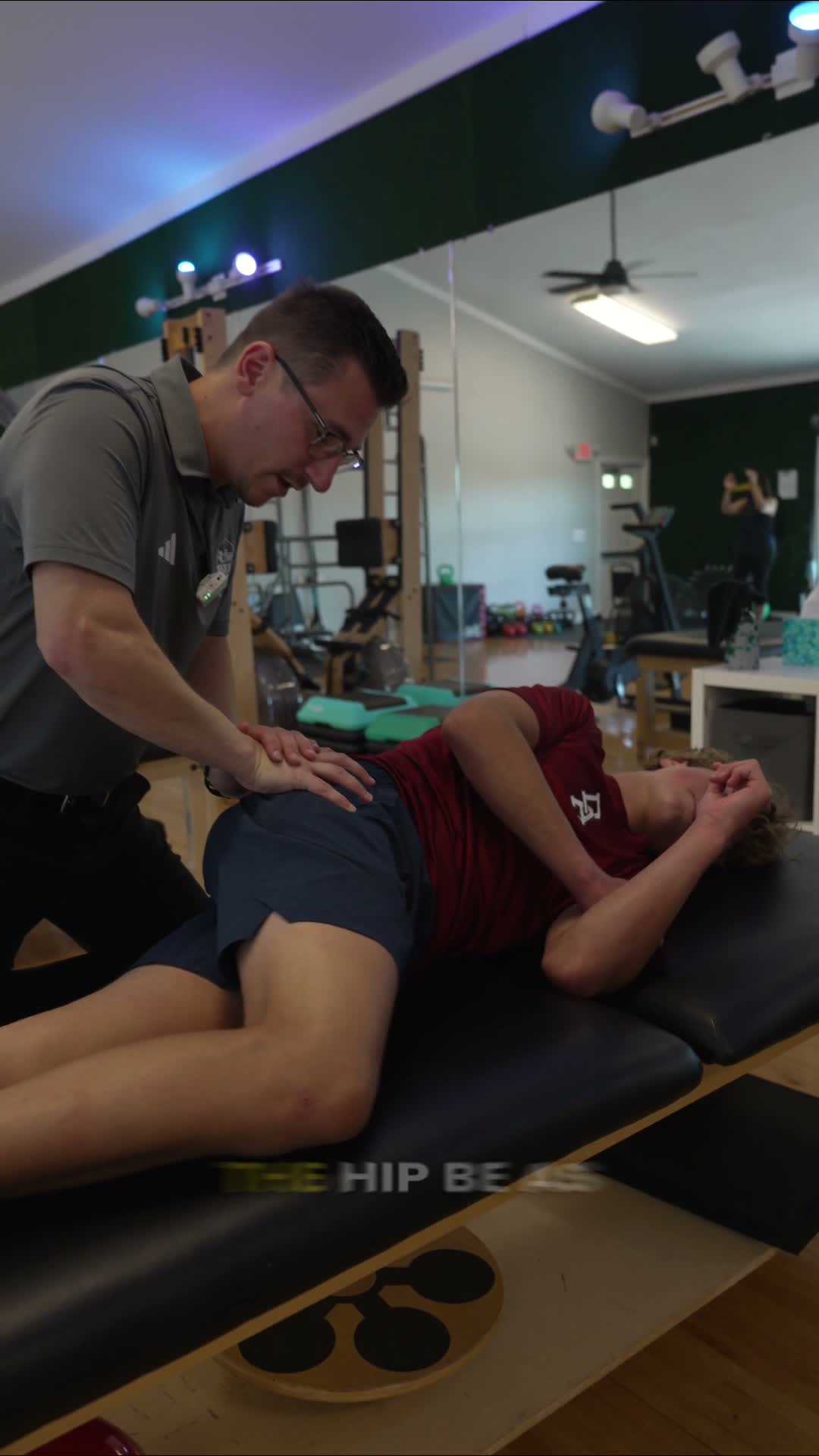
We see growth spurt related back pain in kids who got noticeably taller in a short stretch. Hips get tight, the hamstrings get tight, and the low back ends up absorbing motion the hips are no longer offering. Back pain in a young athlete is worth having assessed rather than waiting out, so the irritated structure is identified rather than guessed at.
Should a growing athlete stop playing?
Often not entirely. Keeping them moving is one of the most important parts of the plan.
The assessment sorts out which tissue is sore, what provokes it, and how much running and jumping their week currently holds. From there the plan is usually to adjust load rather than remove all of it, build calf, quad and hip strength, and clean up the mechanics feeding the irritation. Some athletes do need a real break from running for a stretch, and that call is made case by case. How much time there is matters too: a long off season allows for building, while a mid season flare is about managing volume so the athlete can keep competing.
Where does strength and coordination work fit in?
It is the part that makes the next growth spurt less eventful.
Over fall break, Elleigh worked through full body pulling, pushing, squatting, lunging and stepping. We set the weight and record it so we can compare one session to the next, but at that age the real target is balance and coordination in the patterns she will be using constantly through middle school and high school sports.
But you’re never too young to learn good movement qualities and principles.
The harder part is developmental. Many young athletes are not yet mature enough to train for the sake of getting stronger, so they are focused on what is fun. Elleigh has been open to getting coached on proper movement, which is what lets a session go further. She was back at it before her soccer season continued with Tennessee United.
Key points
- Growth spurts load the growth plates where tendons attach, which is why heel and knee pain cluster in growing athletes.
- Sever’s disease sits at the back of the heel; Osgood Schlatter sits just below the kneecap.
- Growth spurt related back pain often travels with tight hips and hamstrings.
- The usual aim is managing load rather than removing all activity.
- Strength, balance and coordination work is where the long term progress is made.
Frequently asked questions
Does Sever’s disease go away on its own?
Calcaneal apophysitis is generally self limiting once skeletal growth at that site finishes, but that can be a long wait for a kid in season. Most of the work in the meantime is managing training load, calf flexibility and footwear so they can keep playing comfortably.
Is the bump from Osgood Schlatter permanent?
The bony prominence often remains after the symptoms settle. That is a cosmetic finding, not an ongoing problem, as long as it is no longer painful with kneeling and sport.
At what age do you start seeing kids?
We generally start kids around age eight, since that is when most are willing to begin structured exercise and follow coaching. We see them both for sports injuries and for learning good movement before problems appear.
Should my kid ice it or stretch it?
Both can help some athletes, but neither addresses why the tendon is pulling so hard. That is the part an assessment is for: the training volume, the calf or quad tightness, and the mechanics underneath it.
If your young athlete has been limping after practice, rubbing the back of a heel, or complaining about the bump under a knee, book a new patient visit at Active Sports Therapy in Hendersonville. We will work out which tissue is actually sore, what they can keep doing, and what to build while there is time to build it.
Active Sports Therapy · 123 Stadium Drive, Hendersonville, TN 37075 · 615-537-5520
Sources
- James AM, Williams CM, Haines TP. Effectiveness of interventions in reducing pain and maintaining physical activity in children and adolescents with calcaneal apophysitis (Sever’s disease): a systematic review. Journal of Foot and Ankle Research. 2013;6(1):16. https://doi.org/10.1186/1757-1146-6-16
- Circi E, Atalay Y, Beyzadeoglu T. Treatment of Osgood-Schlatter disease: review of the literature. Musculoskeletal Surgery. 2017;101(3):195-200. https://doi.org/10.1007/s12306-017-0479-7
- Lloyd RS, Faigenbaum AD, Stone MH, et al. Position statement on youth resistance training: the 2014 International Consensus. British Journal of Sports Medicine. 2014;48(7):498-505. https://doi.org/10.1136/bjsports-2013-092952
- Stricker PR, Faigenbaum AD, McCambridge TM; American Academy of Pediatrics Council on Sports Medicine and Fitness. Resistance Training for Children and Adolescents. Pediatrics. 2020;145(6):e20201011. https://doi.org/10.1542/peds.2020-1011
Transcript of the video
Go over we set the weight right here so that we can keep track of that. We are going to hit those yellow rose. Nice. challenges What’s your goal for your yard?
You know how they also have it. Now. What do you feel like a 10 pounds last time? That’s a lot more.
Thank you. grow up to the
Leave a Reply