
If your hip started bothering you some time after an ankle injury, the two are probably related. When an ankle will not let the shin travel forward over the foot, walking has to come from somewhere else, and the hip is usually the joint that pays. Andrea named this herself before anyone explained it to her: she did not want the dominoes.
What does ankle dorsiflexion have to do with my hip?
Dorsiflexion is the motion that lets your knee travel forward over your toes while your heel stays down. Every step uses it. When it is missing, the leg has to borrow the motion from a joint that still has some.
Andrea’s ankle had been guarded since a fracture that healed some time ago. The bone was long since solid. The joint and the tissue around it had never let go, so her ankle stopped at a point well short of where it should have been, and her walk quietly reorganized itself around that.
What do people actually do when the ankle will not bend?
There are only a few options, and most people pick one without ever deciding to.
| Compensation | What it costs |
|---|---|
| Picking the heel up early | More work for the calf and the front of the knee |
| Extra bend at the knee and hip | Quad and hip flexor load on every step |
| Turning the whole foot out | The hip rotates outward with each step |
The third one is the common one. What the average patient does not realize is that turning the foot out when you walk is also twisting the hip outward, and that changes the coordination pattern the hip has used your whole life [verify: present out-toeing as a frequent compensation, not a rule].
Why does the hip start hurting when the ankle never did?
Because a stiff ankle is often painless. It is not sending you any signal, so nothing tells you to deal with it. The joint above it is the one that eventually complains.
Andrea already knows she has labral tears in her hip, the labrum being the rim of cartilage around the hip socket. Those tears had been quiet for a long time. Her concern was not that the ankle hurt. It was that continuing to favor the ankle would change her coordination enough to wake the hip up. In her own session she said she did not want to keep favoring it for much longer.
you change your coordination something else has to do it. I don’t want the dominoes.
What did we actually do about the ankle?
We treated the structure that was limiting her, in order, rather than treating everything at once.
- Session one cleared a large amount of muscle guarding around the ankle. Range improved, though less than we wanted.
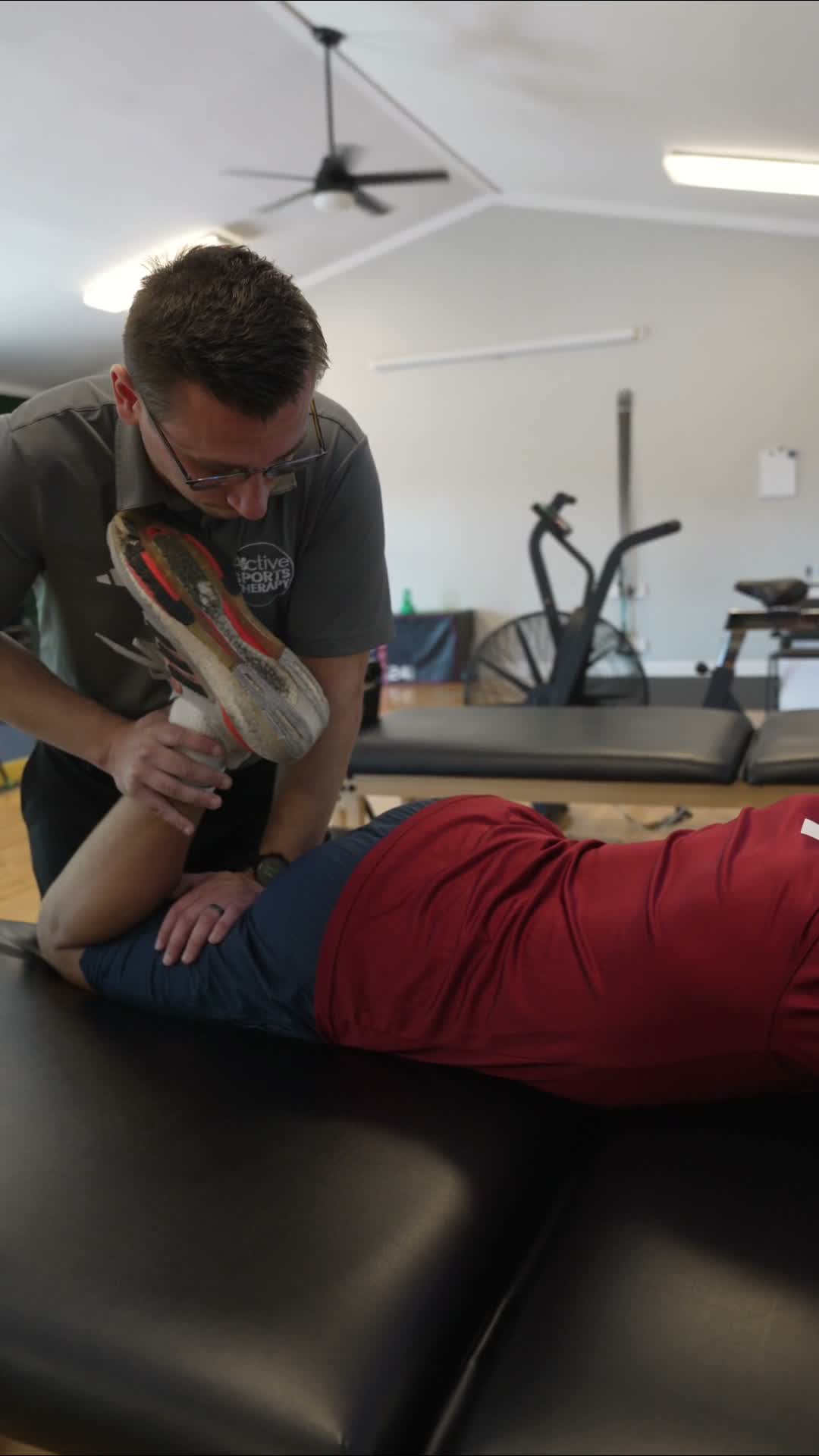
- Session two reassessed every soft tissue reason the ankle would not travel over the toes.
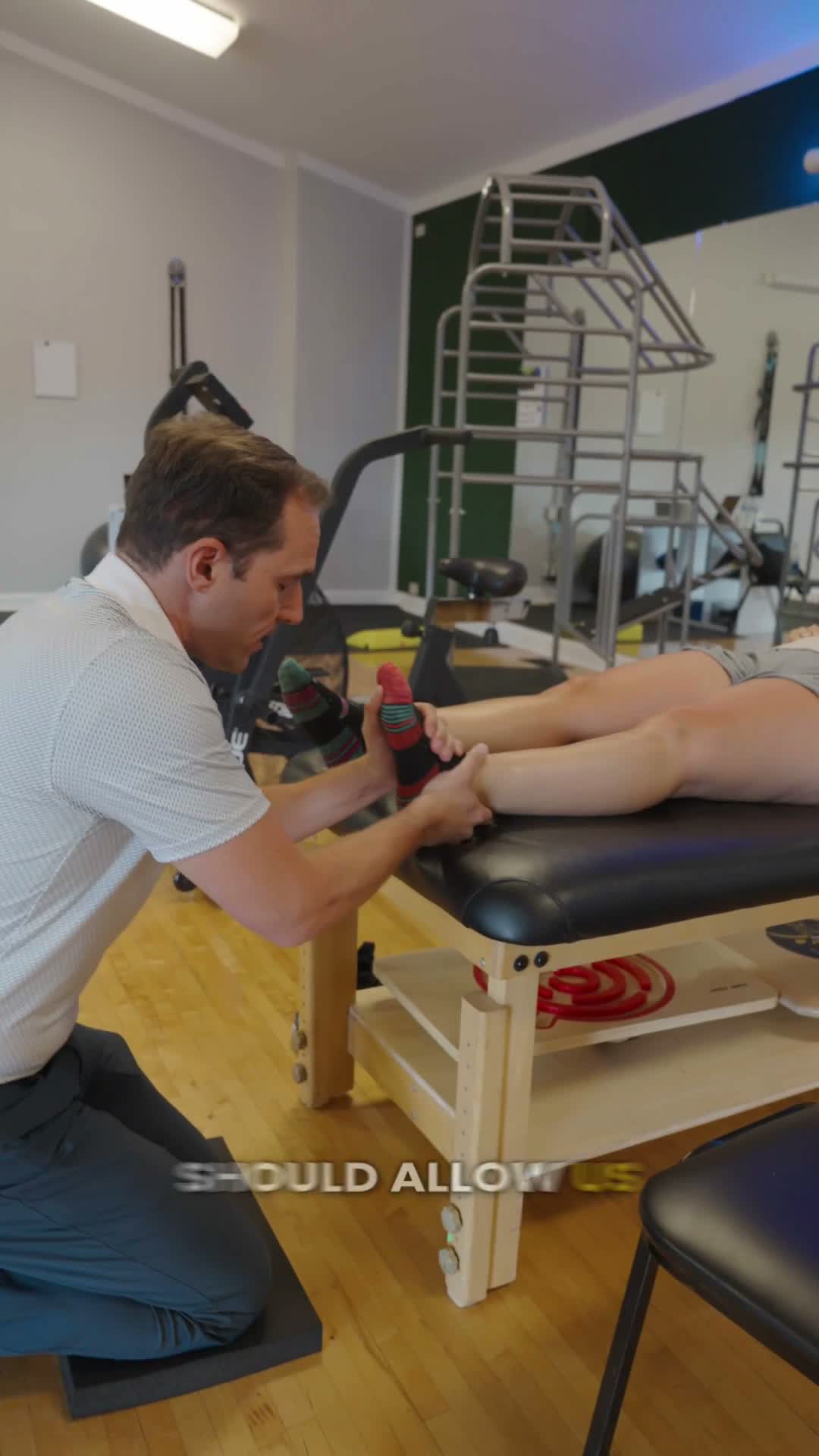
- With the soft tissue handled, the ankle mortise itself was the most guarded and restricted piece left, so Dr. Jason adjusted it.
- The ankle went straight through the new range and got loaded, because range you do not use tends to go back where it came from.
An adjustment here is a rapid, quick stretch at the end of the range the joint already has. Joint pressures change, gas exchange happens inside the joint, and that often carries a brief analgesic effect, meaning short term pain blocking. The point is the window of easier motion afterward.
How long do I have to work on this?
It depends on the time you have. If someone has a long stretch ahead of them with no season or event in the way, we can take a slower route: soft tissue work, graded loading, and patience with the joint. When somebody needs a faster turnaround, the sessions carry more in them, joint work included, and the home work matters a great deal more because the window after each visit is short.
Either way, the earlier it starts, the less walking you have done on the compensation. That is the real argument for not waiting.
Key points
- Missing ankle dorsiflexion has to be made up somewhere, usually at the knee or hip.
- Turning the foot out to walk also turns the hip out, step after step.
- A stiff ankle is often painless, which is why it gets ignored.
- Soft tissue first, joint second, then load the range you just gained.
- Andrea’s plan was built around her own concern: protecting a hip that had been quiet for years.
Frequently asked questions
Why does my foot turn out when I walk?
Often because the ankle will not let the shin travel forward far enough, so the foot rotates to get you past that point. It can also come from hip rotation or simple habit, which is why it gets assessed rather than assumed.
My ankle does not hurt anymore. Does the stiffness still matter?
It can. Many people find that the joint that eventually hurts is the knee or the hip, not the ankle that stopped moving well. Stiffness without pain is still stiffness.
Can old labral tears flare up again?
They can become symptomatic again, particularly when the way you load the hip changes. That is exactly why Andrea wanted the ankle addressed rather than waiting to see what happened.
Is an adjustment safe on an ankle that was fractured?
Once the bone is solid and the treating provider has cleared loading, the ankle is assessed like any other joint. The adjustment is only used when the joint itself is the restriction, and never as the first thing tried.
If your ankle has been tight since an injury, or your hip has started talking to you since then, it is worth having both looked at together. Active Sports Therapy sees this pattern in Hendersonville regularly, and the assessment starts by finding out which joint is actually short on motion. Book a visit here and we will go through it with you.
Active Sports Therapy · 123 Stadium Drive, Hendersonville, TN 37075 · 615-537-5520
Sources
- Bialosky JE, Bishop MD, Price DD, Robinson ME, George SZ. The mechanisms of manual therapy in the treatment of musculoskeletal pain: a comprehensive model. Man Ther. 2009;14(5):531-538. doi.org/10.1016/j.math.2008.09.001
- Kawchuk GN, Fryer J, Jaremko JL, Zeng H, Rowe L, Thompson R. Real-time visualization of joint cavitation. PLoS One. 2015;10(4):e0119470. doi.org/10.1371/journal.pone.0119470
Transcript of the video
But this will be what we call an adjustment but it’s just a quick stretch. It’s the same thing just really quickly. You just be a noodle and it should allow us to open up a little more of that range let that go a little extra feels like well, it feels like it needs to pop. Yeah, and it’s about to let that go there.
I’m sure yeah, that’s exactly needed a bad. And so what that’ll do is that’s gonna let us open up that range really fast and I really want this one spot. There we go. Good.
All right, let’s hop back over here. I bet this listens up big time for us. But that’s what I was talking about after a fracture like that and it’s healing it goes into that Garden mode and stiffens up so bad and we’ve got to just break that loose just think of it like Let The Garden go and then now take it through range and add the string and it’ll come right back. That’s so important to get working on it right away and get that Mobility back because if we don’t it’s going to be totally fine just staying stiff and guarded but that completely changes your function knees gonna be pissy all the time hip issue.
It’s so annoying. He didn’t want to because I have two chairs in my room in this set and my concern was That if I start favorite thing this ankle too much longer that I was going to reach girl what happens all the time you change your coordination something else has to do it. I don’t want the dominoes. Yeah.
I’m with you I’m with you. So we’re gonna make sure that doesn’t happen.
Leave a Reply