When a golfer comes in with low back pain, the next thing we commonly see down the road is adductor pain. We see it all the time. The inner thigh is usually the link, because limited hip rotation and a hard working swing push load into that tissue until it complains, and strengthening it alongside the hip is how we address both.
What do the adductors actually do in a golf swing?
They control the pelvis over a planted leg and help the lower body act as an anchor.
The adductors are the muscles along the inside of the thigh that pull the leg toward the midline. In a swing, the legs are not just standing there. They are the foundation the rotation happens on top of. Think of them like the guy wires on a tent pole: the pole can be perfectly strong, but if the lines are loose the whole thing moves in the wind. That is what a swing feels like on legs that are not strong enough for it.
Why does one golfer strain a groin and another never does?
Because swings distribute load differently, and some bodies ask far more of the inner thigh.
Depending on how your body moves, the adductors in some individuals work way harder than others as part of their swing, especially with the driver. We have seen many groin strains and adductor strains come out of golf swings. The tissue is not weak in an absolute sense, it is weak relative to what that particular swing demands of it, round after round.
How does limited hip rotation turn into groin pain?
Rotation the hip does not have gets borrowed from the back and the groin.
Internal rotation is the hip turning inward, and a swing needs a fair amount of it. Keith was missing a lot of internal rotation at the hip, which is a common finding in golfers who have had low back pain. A stiff hip means the pelvis and the tissue around it take up the slack, and the adductors are right in the middle of that. If we are not strong in the lower body and not maximizing range of motion in the upper back and hips, these areas start to get pinched.
How do we build the inner thigh without flaring it up?
In a progression, starting with a shorter lever and shorter holds.
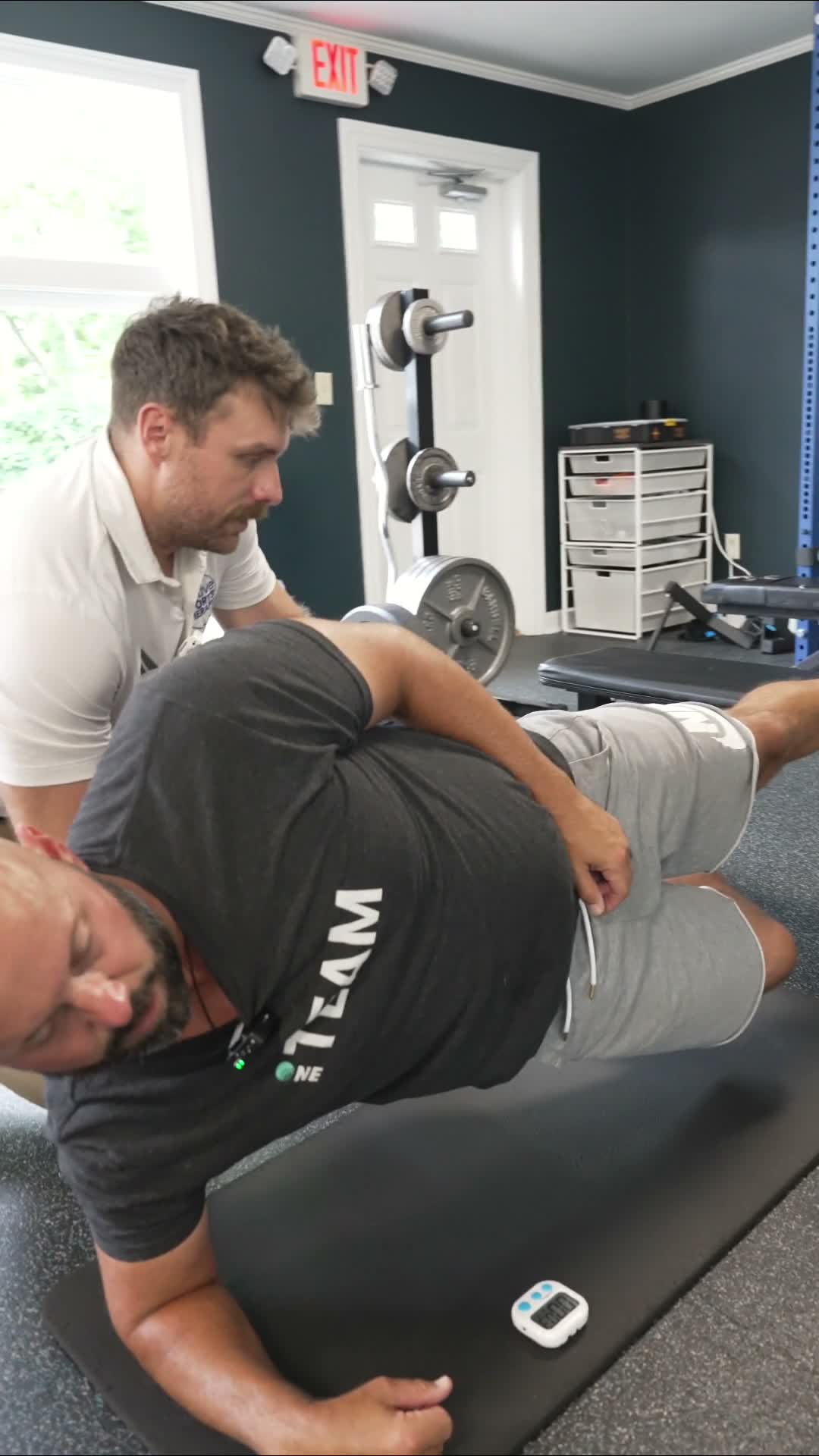
- Start with the short lever Copenhagen, with the top leg supported at the knee.
- Hold a clean line with the hip high rather than chasing a longer time.
- Progress to the long lever, support out at the foot, as Dr. Joel has Keith doing.
- Work both sides, because the swing asks something different of each.
- Pair it with hip mobility, so strength is built through usable range.
Dr. Joel checks in through the set, asking about pinching or pain. That is deliberate. Hard in the inner thigh is the goal; sharp or pinching means the position or the lever length changes. This kind of loading is part of our expert guided rehabilitative exercise, built around the sport rather than a generic list.
Does the plan change if I am mid season?
Yes, the runway decides how hard we push, not whether we work on it.
| Time available | How we approach it |
|---|---|
| An off season or a long stretch | Build strength properly: more volume, longer levers, real hip mobility work alongside it. |
| A tournament coming up soon | Keep loading conservative, lean on hands on care, mobility and movement retraining, then build strength after the event. |
Key points
- Low back pain in a golfer often precedes adductor pain.
- The adductors control the pelvis over a planted leg during the swing.
- Driver swings tend to ask the most of the inner thigh.
- Stiff hips push rotational load into the back and groin.
- Strength and mobility get built together, not one after the other.
Frequently asked questions
Is stretching enough for a tight groin?
Tightness is often a strength problem wearing a stretching costume. Many golfers find the inner thigh feels less tight once it is strong enough for the load, which is why we train it rather than only stretch it.
How long should I hold a Copenhagen?
Less than you think at first. A clean hold with the hip high beats a long sagging one, and the hold time grows as the position stays solid.
Could my groin pain be coming from the hip joint instead?
It can. Hip joint problems, adductor tendon problems and referred pain from the low back can all present in the same area, and they are managed differently. An exam that tests rotation, strength and the specific tissues is what separates them.
Do I need to stop golfing?
Not always. Many golfers keep playing with changes to volume and intensity while the work is going on, and that call depends on what the exam finds.
Golf is one of those things that brings people together, and pain takes that away in a heartbeat. If your back or your groin has been bothering you around your game, book a visit with us and we will check your hip rotation, your upper back and the strength underneath it, then build the plan around your calendar. Active Sports Therapy sees a lot of golfers in Hendersonville and this pattern is a familiar one.
Active Sports Therapy · 123 Stadium Drive, Hendersonville, TN 37075 · 615-537-5520
Sources
- Harøy J, et al. The Adductor Strengthening Programme prevents groin problems among male football players: a cluster-randomised controlled trial. British Journal of Sports Medicine, 2019. https://doi.org/10.1136/bjsports-2017-098937
- Vad VB, et al. Low back pain in professional golfers: the role of associated hip and low back range-of-motion deficits. American Journal of Sports Medicine, 2004. https://doi.org/10.1177/0363546503258912
- Weir A, et al. Doha agreement meeting on terminology and definitions in groin pain in athletes. British Journal of Sports Medicine, 2015. https://doi.org/10.1136/bjsports-2015-094869
Transcript of the video
Is this more challenging than what you’re doing earlier? Okay good. Now how about this way? If you feel anything any pinching, nope, next piece of what we’re doing with them is going to be called The Copenhagen hold so big one for Keith was he was missing a lot of internal rotation at the hip and what this is going to be doing is strengthening up those adductors big thing for the golfers.
If they sort of in low back pain, the next thing this shows up is going to be adductor pain. We see it all the time. So we have to make sure those stay strong and they stay mobile for him. So he’s gonna show us how he’s doing his Copenhagen holder right now.
So Keith, let’s have you said it up. He’s a pro at this. So he’s doing what we call the long lever. So he’s reaching all the way from the foot and he’s bridging up and then he’s holding all the way through here.
So it’s really making that out after work work hard, but he’s also getting a ton of core work out of this as well. So keep this hip nice and high good. Any pain here? Nope, awesome.
So awesome there and then he’s going to hit both sides.