
A quad that has lost length, especially the rectus femoris, which crosses both the hip and the knee, can limit motion well beyond what a simple stretch shows. When that length is missing, many people compensate by arching through the low back instead of actually lengthening the thigh. That compensation can mask the real restriction and shift stress onto the low back instead of restoring the hip and knee motion an athlete actually needs.
Why does the classic runner stretch sometimes miss the thigh?
Most people learn the same stretch in school: stand up, reach back, and pull the heel toward the seat. For a lot of people that works exactly the way it looks. But if the front of the thigh has lost normal length, pulling the heel back does not lengthen the muscle at all. Instead, the low back arches and the pelvis tilts forward to make up the difference, so the stretch feels like it is working when the real tissue barely moved.
What is actually tight when an athlete can’t get their heel to their seat?
The muscle usually involved is the rectus femoris, one of the four quad muscles. It is unusual among them because it crosses two joints instead of one, acting as both a knee extensor and a hip flexor, the muscle group that lifts the thigh toward the body. When it shortens, it limits motion at the hip as well as the knee, which is part of why a simple thigh stretch does not always resolve it.
Why do young athletes lose this motion in the first place?
During a growth spurt, bones often lengthen faster than the muscles around them, and a packed training schedule does not leave much room to catch up. Dr. Jordan sees this pattern often in young athletes training daily.
But it’s a classic thing these young athletes. I mean, they are constantly grinding.
Daily practices without much dedicated stretching time can let this tightness build quietly for months before it shows up as a limitation.
How does Dr. Jordan check and correct it during an evaluation?
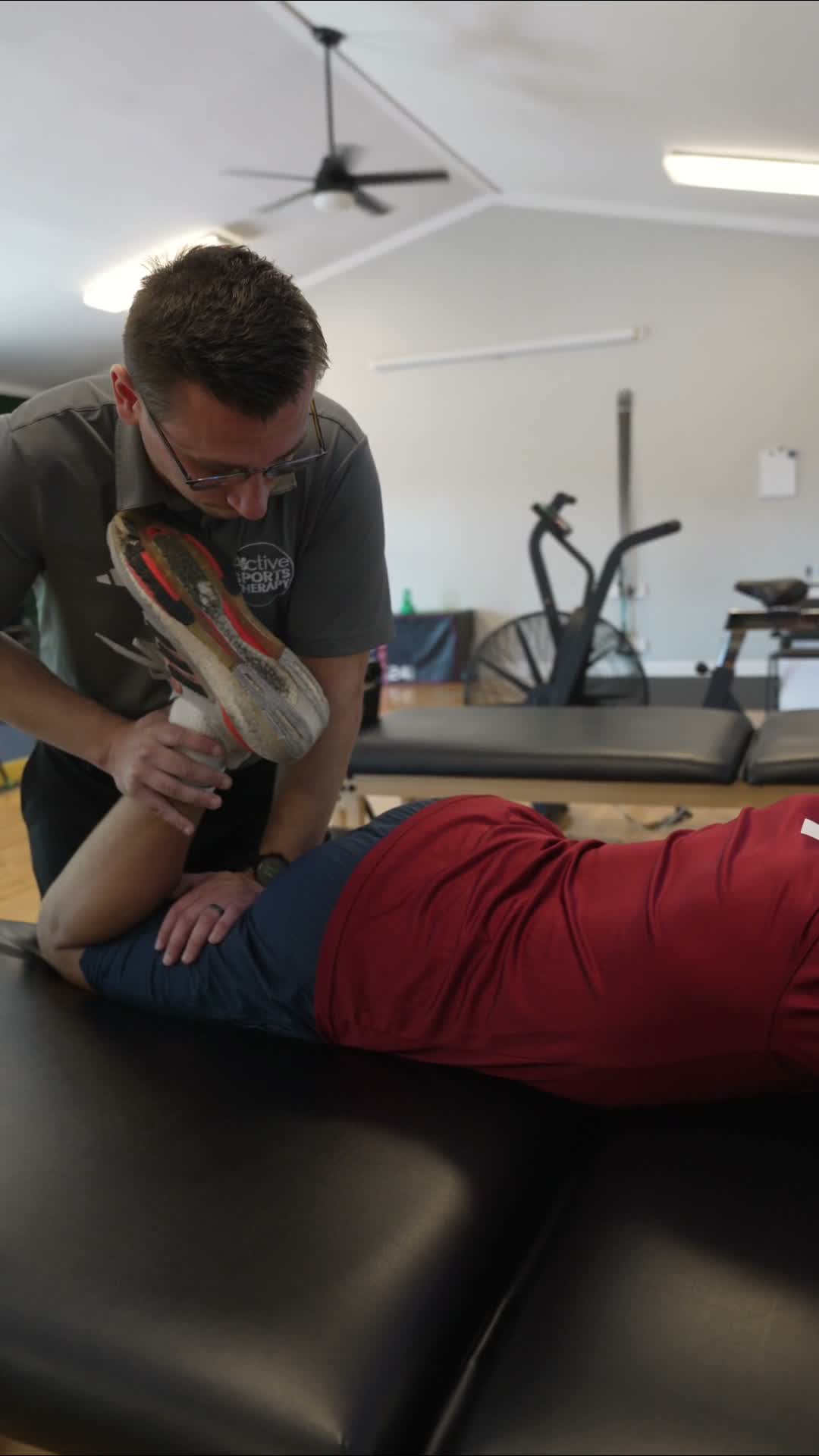
The evaluation starts by removing the low back from the equation, so the only motion being measured is the hip and thigh. From there, a contract and relax technique, a stretching method where the muscle is briefly contracted against light resistance and then relaxed into a longer position, is used to work through the restriction without letting the low back take over.
- Position the hip and knee in the stretch position, with the low back supported and still.
- Have the athlete gently kick out against light resistance.
- Relax the muscle fully.
- Add a glute squeeze on the same side to target the upper portion of the quad.
- Recheck how close the heel comes to the seat without the low back arching to help.
For this athlete, that process let the heel move closer to the seat within the session, with the tightness concentrated in the upper part of the quad. That is one athlete’s result in one evaluation, not a timeline anyone else should expect.
Key points
- The rectus femoris crosses both the hip and the knee, so tightness there limits more than the thigh.
- A stretch that looks deep can really be low back compensation rather than real lengthening.
- Growth spurts and daily training are common reasons young athletes lose this length.
- Contract and relax cueing can help isolate the muscle so the low back cannot help out.
- An evaluation can tell whether a restriction comes from the hip flexor itself or from compensation elsewhere.
Frequently asked questions
Why does my child’s hip feel tight after a growth spurt?
Bones can lengthen faster than the muscles crossing them during a growth spurt, which often shows up as tightness in the front of the hip and thigh. It is common in young athletes who are also training heavily during that same stretch of growth.
Is it normal for athletes in daily practice to feel tight in the front of the thigh?
It is common, especially without much dedicated stretching time built into a daily schedule. Common does not mean it should be ignored, since it can affect hip and knee motion over time.
Can stretching on my own fix this, or do I need an evaluation?
Some people improve with consistent stretching alone. Others are unknowingly compensating through the low back every time they stretch, which an evaluation can identify.
What is the difference between a hip flexor and a quad muscle?
The quads are a group of four muscles on the front of the thigh that straighten the knee. One of them, the rectus femoris, also crosses the hip and helps lift the thigh, which is why it is counted as a hip flexor too.
If tightness like this has been limiting practice or performance, book a new patient visit at Active Sports Therapy and we will check whether the restriction is coming from the hip flexor itself or from compensation elsewhere in the chain. We see this pattern often in young athletes training in Hendersonville through a demanding season.
Active Sports Therapy · 123 Stadium Drive, Hendersonville, TN 37075 · 615-537-5520
Sources
- Neumann DA. Kinesiology of the hip: a focus on muscular actions. J Orthop Sports Phys Ther. 2010;40(2):82-94. https://doi.org/10.2519/jospt.2010.3025
- Sharman MJ, Cresswell AG, Riek S. Proprioceptive neuromuscular facilitation stretching: mechanisms and clinical implications. Sports Med. 2006;36(11):929-939. https://doi.org/10.2165/00007256-200636110-00002
Transcript of the video
A lot of people can say like oh I can touch my healer in my butt. But whenever we take a lot of that out now we get to truly see how much rain she’s got. And this is why we did that initial test because we saw that the quads differently were tight. He’s been training like crazy how many practices a week right now?
Every day, right? So he feels every bit of the training now. We just want to see how much can we lose in this up for him and get his motion back. So we keep performing well, and now once you’re in the position, I want you to actually kick your leg on out to me.
Good. Just meet my pressure. Yep. And then relax it and now we see his heel get closer and closer to but now gold standard on this is being able to get heel all the way to butt and be able to make sure that we take all that tension out of the front part of the thigh.
But it’s a classic thing these young athletes. I mean, they are constantly grinding. Good kick on out to me. And let it relax.
Good now how we feel in here. Where do you feel most? The top part of the Quad. Yeah.
Good now while we’re here, I want you to actually squeeze your butt on the right side. Squeeze squeeze squeeze squeeze squeeze now, this is gonna get after that higher part of that quad, right?
Leave a Reply