
Reviewed October 2026 by Dr. Jason Hulme DC, DACBSP®, Dip Med Ac
If your knee swells after training and then feels weak rather than simply sore, that is not your imagination. Fluid inside the joint physically blocks the last part of the range, and it also dampens how well the muscles around the knee switch on. That is why a swollen knee loses depth in a squat and feels like it might give way, and it is why we deal with swelling before we add load back.
What is actually inside the knee when it swells?
The fluid is inside the joint capsule, not in the muscle. Clinicians call that an effusion. It is produced by the joint lining in response to irritation, and it takes up space that the joint needs to close.
Picture a door hinge with a water balloon pushed into it. The hinge still swings through most of its arc. It just refuses the last part, and anything that asks for the end of the range feels blocked and sore. A squat asks for exactly that.
Why does a swollen knee feel weak as well as tight?
Swelling in a joint reduces how strongly the surrounding muscles contract, even when nothing is torn. The nervous system turns the volume down around a joint it reads as irritated.
For a lifter this shows up as asymmetry long before it shows up as pain. One side takes a little more of the bar, depth drops on the swollen side, and the whole lift feels off balance. Chasing that with more squatting usually makes the joint produce more fluid, which is why the swelling has to be dealt with first.
How did we find the swelling in Ahmed’s knee?
We used three checks and we wanted them to agree before treating anything. Ahmed is a powerlifter and a world record holder in his division, and after major competition that knee tends to collect fluid.
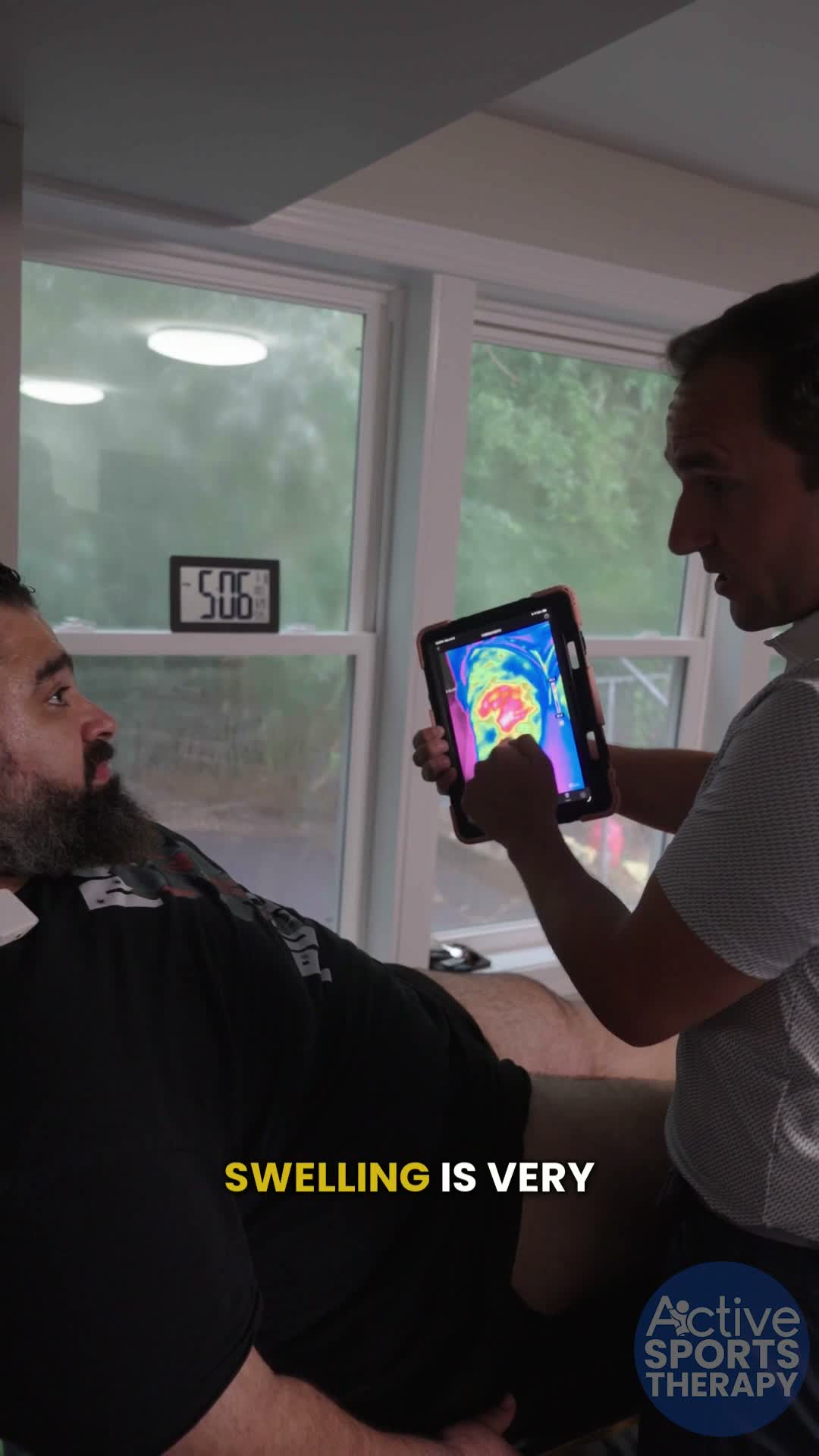
First, surface temperature evaluation. One small area of red and yellow sat on the involved knee, with nothing comparable on the other side.
That’s not supposed to be there at all. That’s where the swelling is. Very obvious on this knee.
Second, hands on assessment of the same region. Third, a loading test: a body weight squat and then a light kettlebell. Ahmed pointed at the same spot the thermal reading had flagged and called it a five out of ten.
| Finding | What it tells us |
|---|---|
| Surface temperature evaluation | Where the irritation is, and whether the other side looks the same |
| Hands on assessment | Whether the fluid and tenderness match what the screen showed |
| Loaded squat test | Whether that area is actually the thing limiting the lift |
What did we do once we knew where it was?
We used Deep Blue Cryo, a cold physical agent modality, to bring the swelling down. It is loud, it is very cold, and the application is short.
For Ahmed, the swelling came down and the pain pattern he had just rated settled enough that we could move into strength symmetry work in the same visit. That was his response on that day. Someone else with a different knee and a different history may respond differently, so we recheck rather than assume.
The reason speed mattered here is the calendar. A competitive lifter cannot sit in a long deload and still arrive prepared for the next cycle, and a secondary goal in his case was keeping corticosteroid use to a minimum where other options can carry the load. Those injections are a physician’s procedure, not ours. Our part is assessment, swelling management with modalities, and the rehabilitative work afterward.
Key points
- An effusion is fluid inside the joint capsule, not soreness in the muscle.
- Joint swelling reduces muscle activation, so a swollen knee feels weak as well as tight.
- Lost squat depth and side to side asymmetry are often the first signs.
- We want a thermal reading, a hands on exam and a loaded test to point to the same place.
- What happened for Ahmed in one session was his result, not a prediction for anyone else.
Frequently asked questions
Why does my knee feel weak when it is swollen but nothing is torn?
Fluid in the joint reduces how strongly the quadriceps contract, which is well described in the research on knee effusion. The strength often returns as the swelling settles, though specific rehab is usually needed to rebuild it fully. An assessment tells you whether there is more going on than fluid.
Should I keep squatting through a swollen knee?
Loading a joint that is still full of fluid tends to keep the swelling going, and the pattern you train in that state is usually a compensated one. We would rather take the swelling down, recheck how the knee loads, then progress from there. That decision should be made on your own examination findings.
Is ice the same thing as what you used?
Deep Blue Cryo is a cold therapy device used for a short, targeted application rather than a bag of ice on the couch. We use it for specific findings, and we recheck afterward to see whether anything actually changed. Cold is a tool, not a routine we apply to everyone.
When should a swollen knee be seen by a doctor?
A knee that swells rapidly after a twist or an impact, that locks, that gives way, or that is hot and painful with fever needs prompt medical attention. We assess and we refer when the picture calls for imaging or a physician’s opinion. If you are unsure, get it looked at.
Book a visit
If your knee puffs up after heavy training and your squat has quietly gone asymmetrical, that is worth sorting out before it becomes a season of working around it. Book a visit here and we will assess the joint, test it under load, and show you what we find. Active Sports Therapy is here in Hendersonville and we see a lot of lifters.
Active Sports Therapy · 123 Stadium Drive, Hendersonville, TN 37075 · 615-537-5520
Sources
- Palmer JE, et al. The effect of knee joint effusion on quadriceps activation: a review. https://pubmed.ncbi.nlm.nih.gov/31294964/
- Hart JM, Pietrosimone B, Hertel J, Ingersoll CD. Quadriceps activation following knee injuries: a systematic review. Journal of Athletic Training. https://doi.org/10.4085/1062-6050-45.1.87
- Rice DA, McNair PJ. Quadriceps arthrogenic muscle inhibition: neural mechanisms and treatment perspectives. Seminars in Arthritis and Rheumatism. https://doi.org/10.1016/j.semarthrit.2009.10.001
Transcript of the video
it in that amazing so we can push out that inflammation immediately dwellings. What we’re gonna do is we’re gonna do deep blue Cryer today. We’re gonna knock that swelling down. So it’s really good.
So cool. But you see how red and the yellow is here. That’s not supposed to be there at all. That’s where the swelling is.
Very obvious on this knee. That’s not on the other day right now just body weight squad or with a light kettlebell and see how much you’re feeling it. Feel real. Yeah.
And where would you say if you feel and that’s literally where the slowing is all on the internet the exact same spot me. So what we’re gonna do is we’re gonna treat that out and then we’re gonna see how that goes after out of 10. How much would you say you’re feeling that right now five? Okay.
All right. Let’s have you over here on the table for me. Are you ready baby? Okay now, so anyway the thing about this is so and it’s very cold.
That’s it. That’s why it’s just loud and cold. We’re gonna have some fun. You ready?
All right, here we go. Any ache in it and that amazing so we get push out that inflammation immediately if it’s so cold, but I’ll see good.
Leave a Reply