Reviewed September 2026 by Dr. Jason Hulme DC, DACBSP®, Dip Med Ac
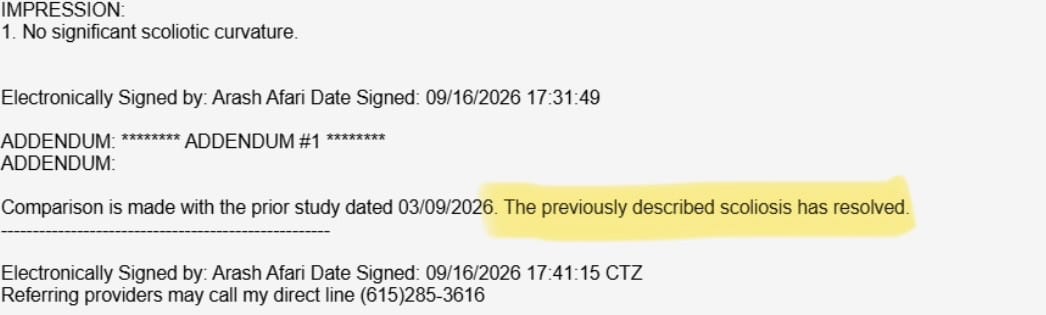
Success with adolescent scoliosis rarely looks dramatic in the room. It looks like a curve that gets measured properly, cared for while the child is still growing, and then watched over time. For one of the adolescents we worked with, it looked like a follow-up radiology report that read that the previously reported scoliosis has resolved. That was that young person’s result, on their own timeline, and it stays theirs. What follows is how we think about this care, not a prediction for anybody else’s child.
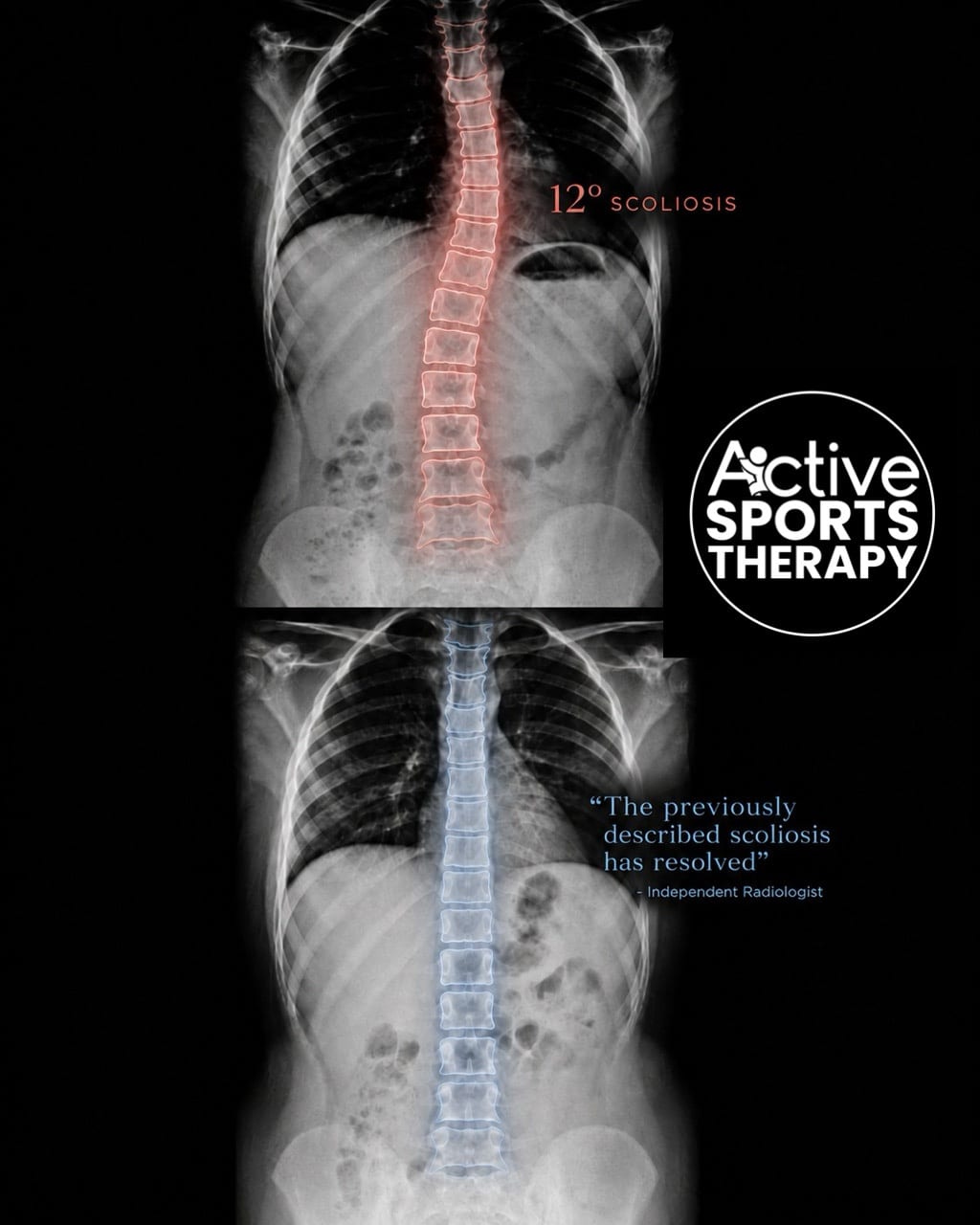
Photograph: before and after Active Sports Therapy Scoliosis Care.
What did success look like for this one adolescent?
It started as a 10 to 12 degree thoracic curve, and it ended with a radiology report that no longer described a scoliosis.
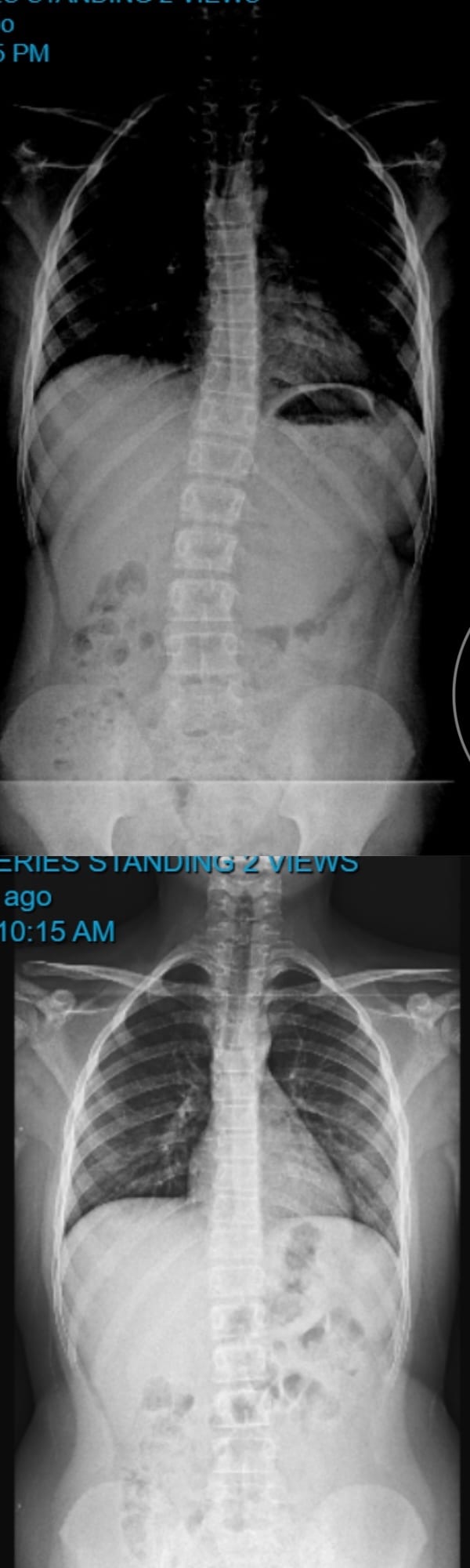
When we met this adolescent, the curve sat in the thoracic spine, the mid-back, measured in the 10 to 12 degree range. The adolescent was highly interested in balancing that out and wanted to participate in sports, football in particular. The parents were concerned about the trajectory. They had family members with worsening scoliosis and knew how that had shaped those lives. All patient data has been removed from the images, and the part that matters is the radiologist’s wording on the follow-up read.
When is adolescent scoliosis usually caught, and why are we seeing it late?
Most detection happens between about ages 10 and 12, and fewer school screenings mean more curves are being found later than they used to be.
In our office we most regularly see detection between 10 and 12 years old. In girls it tends to be closer to 10, and in boys closer to 12. Idiopathic scoliosis simply means a curve with no single identified cause, and it is the common type in this age group.
| Group | Age we most often see it detected |
|---|---|
| Girls | Closer to 10 |
| Boys | Closer to 12 |
We have found that schools do far fewer spinal screenings than they used to, so there is a clear need for more eyes on this. Most kids go back to the pediatrician for sickness or for vaccine updates. They are not often going back for a standard physical, so curves are getting overlooked, or nobody is looking at all. National screening recommendations have been debated for years, which is part of why routine school programs thinned out.
What is a Cobb angle, and why do we order an x-ray series?
A Cobb angle is the measurement of how far the curve travels, taken at the apex of the curve on an x-ray. It is the number that tells us what we are actually dealing with.
When we perform a scoliosis screening, we can pick up curves at a pretty low degree, between 5 and 10 degrees. At that point we standardly order a scoliosis x-ray series. We prefer Premier Radiology, either here in Hendersonville or in Gallatin. They do a good job getting the images uploaded into their online system quickly, which gets them over to us fast. From the series we measure the Cobb angle, and from there our job is to work on de-rotating the spine as much as the body will allow, alongside very specific individualized strengthening and sports therapy.
Why do these kids look flexible but still fail a toe touch?
Because we usually catch them in the middle of a growth spurt, when the long bones are outpacing the soft tissue.
Something we see over and over with this group is that they tend to be on the more flexible side, and yet they often have a very poor toe touch. Whether that is selection bias or not, we always seem to catch them during a growth spurt. The long bones are growing faster than the muscles and nerves, and that is exactly when they show up, and exactly when care needs to get started.
When you have met one adolescent with scoliosis, you have met just one adolescent with scoliosis.
Dr. Jason says that often, and it drives the whole plan. How you connect with each young person is different, and the exercise progression each one needs is different. That is why the movement evaluation, not the image, sets the program.
How is the care actually built?
Stabilizers first, general strength second, and a home program the adolescent owns.
- A movement evaluation to see how this particular young person loads, breathes and controls their trunk.
- Work on de-rotating the spine as much as the body allows.
- Strengthening the stabilizing muscles of the spine, following key principles from dynamic neuromuscular stabilization, a method that retrains the coordination and breathing patterns the trunk develops in infancy.
- Curve specific positioning and breathing work drawn from the Schroth method, which is a well studied approach to exercise for scoliosis.
- Building overall general strength, then handing the program over so they are strengthening at home and understanding the principles.
In an ideal world, our initial treatment plans run a few months of working together on gaining significant strength. After that we follow up on a management basis as needed, rechecking screening every few months to make sure the curve is holding and that the results this family worked hard for are being maintained. Decisions about bracing or surgery belong to the treating physician or orthopedic specialist, and we are glad to coordinate.
Why does a curve at twelve matter at forty?
Because the load on the spine is uneven, and over decades that uneven load shows up in the joints.
Severe scoliosis can sometimes lead to spinal instrumentation such as Harrington rods, but the more common story is slower. Once a curve gets past a certain degree, in the thirties in particular, things get more challenging. The lumbar facet joints are the hinges of the spine, and with a curve they tend to carry more load on one side than the other. Like a door hinge that has been pulled on from one angle for years, that side wears differently. We frequently meet somebody at 40 who has more arthritis on the weight bearing side of the facet joint, and that can lead to injections in the spine and sometimes a lumbar fusion down the road. Getting to a young spine while it is still growing is the whole reason we push on screening.
Key points
- We most often see adolescent scoliosis detected between ages 10 and 12, closer to 10 in girls and closer to 12 in boys.
- Fewer school spinal screenings and fewer standard physicals mean curves are being found later.
- A scoliosis x-ray series and a Cobb angle measurement tell us the size and apex of the curve.
- Care at Active Sports Therapy is built from a movement evaluation, using key principles from dynamic neuromuscular stabilization and the Schroth method.
- One adolescent’s follow-up report read that the previously reported scoliosis has resolved; that result is theirs and is not a promise for anyone else.
Frequently asked questions
At what age should my child be screened for scoliosis?
The window we see most often is roughly 10 to 12 years old, a little earlier in girls and a little later in boys. Since school screenings have thinned out and many kids only see a pediatrician when they are sick, it is worth asking for a spine check during the growth spurt years.
Does a small curve need an x-ray?
When a screening puts a curve in the 5 to 10 degree range, we standardly order a scoliosis x-ray series so we can measure the Cobb angle rather than guess at it. The number gives us a baseline to compare against on follow-up.
Can exercise change a scoliosis curve?
Research on curve specific exercise, including the Schroth method, suggests it can help with curve magnitude and trunk symmetry in growing adolescents, and results vary from person to person. That is why the progression is individualized and why we recheck rather than assume.
Why does my flexible child struggle to touch their toes?
Many of the adolescents we see are generally flexible and still have a poor toe touch, which fits with being mid growth spurt. The long bones grow faster than the muscles and nerves, and the soft tissue is catching up.
If your child has been flagged on a screening, or you have watched scoliosis in your own family and want a curve looked at properly, we would be glad to take a look. We will do a movement evaluation, measure what needs measuring, and build a strengthening plan that fits your kid. Book a new patient visit here.
Active Sports Therapy · 123 Stadium Drive, Hendersonville, TN 37075 · 615-537-5520
Sources
- Negrini S, et al. 2016 SOSORT guidelines: orthopaedic and rehabilitation treatment of idiopathic scoliosis during growth. Scoliosis and Spinal Disorders. 2018;13:3. https://doi.org/10.1186/s13013-017-0145-8
- Kuru T, et al. The efficacy of three-dimensional Schroth exercises in adolescent idiopathic scoliosis: a randomised controlled clinical trial. Clinical Rehabilitation. 2016;30(2):181-190. https://doi.org/10.1177/0269215515575745
- US Preventive Services Task Force. Screening for adolescent idiopathic scoliosis: recommendation statement. JAMA. 2018;319(2):165-172. https://doi.org/10.1001/jama.2017.19342
- Weinstein SL, et al. Effects of bracing in adolescents with idiopathic scoliosis. New England Journal of Medicine. 2013;369(16):1512-1521. https://doi.org/10.1056/NEJMoa1307337
Leave a Reply