
Reviewed September 2026 by Dr. Jason Hulme DC, DACBSP®, Dip Med Ac
Why does a young athlete’s hip tightness show up as low back pain?
When a young athlete’s hip cannot flex as far as it needs to, the low back usually picks up the difference, and that extra motion at the low back is where symptoms tend to start. This is one of the modifiable risk factors we look at once an athlete is out of pain, a term for a physical factor tied to how the body moves that can actually be changed with rehab, as opposed to something fixed like age or height. In this case, that factor is hip range of motion, and specifically how far the hip can flex.
What do we check first when a young athlete comes in hurt?
The first question with any young athlete is whether a growth plate is involved. A growth plate is the area of developing cartilage near the end of a child’s bones where new bone growth happens, and because it is still developing it needs to be ruled out before anything else is considered. Once we know it is not a growth plate injury, the next steps are working out the actual diagnosis, getting the athlete out of pain, and then figuring out why the injury happened in the first place. That last step is what determines whether it is likely to come back.
- Rule out a growth plate injury
- Find the actual diagnosis
- Get the athlete out of pain
- Work out the modifiable risk factors that made it more likely, and address them
Why does the adductor magnus limit hip flexion so often?
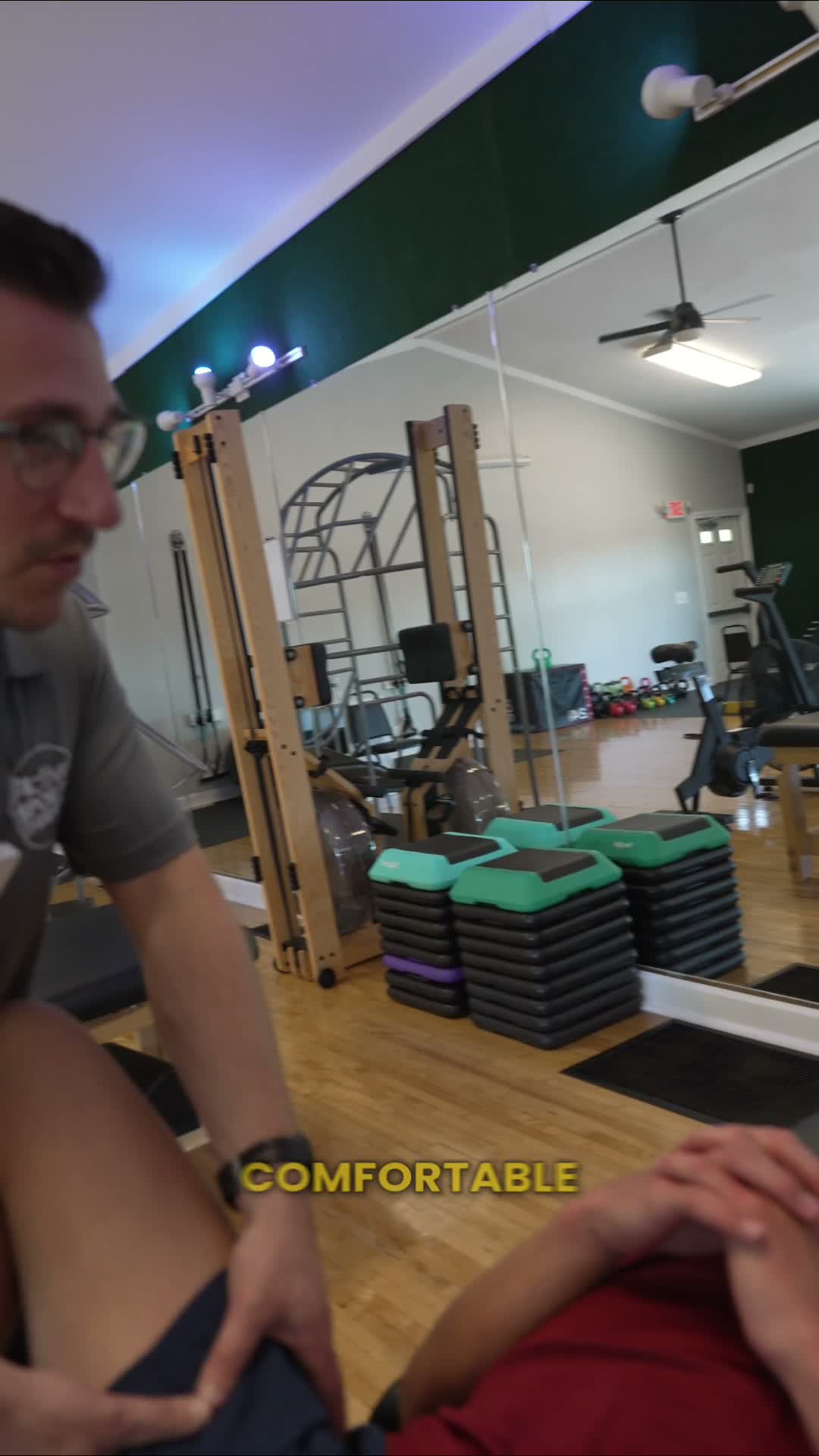
In this video, Dr. Jordan is working with one of our young athletes, 13 years old, on hip range of motion, specifically the ability to flex the hip. The adductor magnus, a large muscle that runs from the pelvis down the inner thigh, is the muscle that most commonly limits how far someone can bring their hip up toward their chest. Working through that tissue is not comfortable, and it shows on his face in the clip, but as it responds the range improves a little before the same pinch shows up further along. That pattern, more range, then a pinch further out, is what we are tracking through a session.
Symptoms are going to come on. It’s not if but when.
Which sports ask the most of hip flexion?
Hip flexion matters more in some sports than others, and this athlete’s training makes it relevant to him specifically.
- Catching in baseball, which holds the hips in a deep flexed position for long stretches of a game
- Any sport built around squatting
- High speed running
- Climbing
All of these ask the hip to flex well, and all of them will find a way around it if the hip will not cooperate. The body is built to move well through its major joints, the shoulders and the hips especially. When one of those joints will not move the way it is supposed to, the region right next to it, in this case the low back, ends up moving more than it should to make up the difference.
What does it mean to optimize an athlete instead of just treating the pain?
Getting a young athlete out of pain is not the finish line. The next question is how to keep them training without the same pattern showing back up. That means looking at how much training the athlete’s schedule involves and whether the body can actually support it, not simply removing the training. Some of that training load is going to stick around no matter what, so the real question is whether the system, the athlete’s hips, shoulders, and the way they move, can be optimized enough that training days can continue successively through the week instead of being interrupted by the same issue over and over.
Key points
- Limited hip flexion often forces the low back to move more than it should
- The adductor magnus is a common muscle limiting hip flexion
- Growth plate injury is ruled out first in any young athlete
- Catchers, squatting sports, running and climbing all demand a lot of hip range of motion
- Addressing modifiable risk factors is part of reducing how often an injury returns
Frequently asked questions
Why does my child’s hip feel tight after practice?
Tightness around the hip, especially the inner thigh, is often related to how much the hip is being asked to flex in their sport. It does not always mean an injury on its own, but persistent tightness alongside pain elsewhere, especially the low back, is worth having assessed.
Is working on adductor tightness uncomfortable?
Soft tissue work on the adductor, especially the adductor magnus, is not the most comfortable area to work through. Most young athletes tolerate it, and range of motion typically improves through a session as the tissue responds.
How do you know it isn’t a growth plate injury?
We start every evaluation of a young athlete by ruling out the growth plate, the area of developing cartilage near the ends of a child’s bones, before considering anything else. That comes first, ahead of any conversation about mobility or training load.
Can my child keep training while working on this?
Often yes. Part of the goal in this kind of rehab is not just removing pain but optimizing the athlete so training days can continue successively through the week rather than being interrupted.
If your young athlete has hip tightness, recurring low back pain, or an injury that keeps coming back, Active Sports Therapy in Hendersonville works through the movement patterns behind it, not just the pain. Book a new patient visit and we will find out what is actually limiting them.
Active Sports Therapy · 123 Stadium Drive, Hendersonville, TN 37075 · 615-537-5520
Sources
- Wainner RS, Whitman JM, Cleland JA, Flynn TW. Regional interdependence: a musculoskeletal examination model whose time has come. J Orthop Sports Phys Ther. 2007. https://doi.org/10.2519/jospt.2007.2416
- Bahr R, Krosshaug T. Understanding injury mechanisms: a key component of preventing injuries in sport. Br J Sports Med. 2005. https://doi.org/10.1136/bjsm.2005.018341
Transcript of the video
You can see it on his face right now. He doesn’t love that. But the inside part of the hip you’re the adductor is actually massive to be able to get your hip range of motion back, especially when you’re flexing up. So we’re working through as we get closer that muscle towards the hip.
And specifically the adductor Magnus is going to be the most common one that limits this and I mean he can tell you everything about it. We are right on that area. Not the most comfortable soft tissue. It’ll be the first to tell you.
and then when we drive back on up We had a little bit further before that pinch hits again, right? And so that’s what we’re at at this point. We’re looking at how to optimize the athlete not just be able to take everything away with how much you are training. Some of that information will still stick around but can we optimize the system to make it so that you can keep these training days successively throughout the week.
That’s a little better.


Leave a Reply