
If your calf feels weak and strangely unfamiliar after an ankle fracture, two things are usually true at once. The muscle lost size and strength during the stretch when you were not allowed to load it, and the fast connection between your brain and that muscle got fuzzy. Rehabilitative care after a fracture has to rebuild both, which is why the first heel raises often look slower, more supported and more deliberate than people expect.
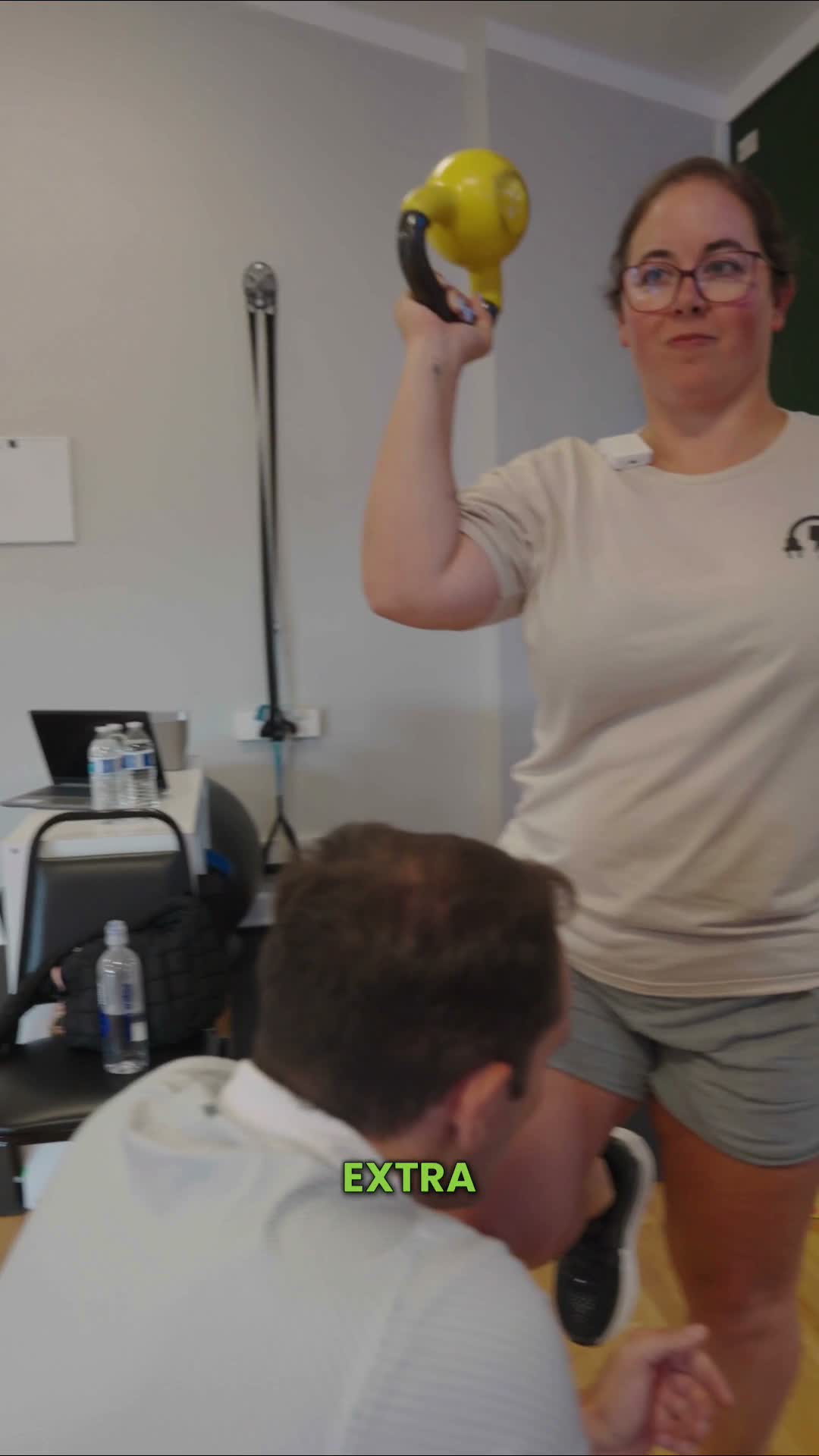
Andrea is working through exactly that phase. She is reloading her calf after an ankle fracture, pressing a kettlebell bottoms up, using her other arm for assistance through the range.
Why does my calf feel weak and clumsy after the boot comes off?
Because it has not been asked to do its job in months, and because the brain quietly stopped rehearsing the movement while you were off the leg.
A calf that has not pushed off against body weight for a long time loses muscle, loses endurance and loses the ability to produce force quickly. That part most people expect. The part that surprises them is the clumsiness: the leg feels like it belongs to somebody else, the rise is wobbly, and the calf may start to feel like it wants to cramp partway up. Walking in a boot for a long stretch changes how the calf is used even while you are upright, so coming out of it is a reintroduction, not a resumption.
What is neurological smudging?
Neurological smudging is the term for the brain’s map of a body part getting blurry after that part stops being used. The connections are still there. They are just slower and less precise.
One of the ways it has been explained comes from studies where researchers put a person’s hand in a mitt for a period of time and then watched what happened to the brain’s representation of that hand. The quick synapses, the accurate finesse movements made in a very short window, degrade. Now imagine a few months after a fracture when you are not allowed to put weight through the leg at all. The same phenomenon applies, and it is why someone can look strong on a machine and still feel shaky on a single heel raise.
Why is the kettlebell held bottoms up?
Because a bottoms up hold forces alignment. It will not stay balanced if the shoulder, trunk and ankle drift out of position.
One of our goals is making sure Andrea maintains her balance and keeps her weight over the big toe as she goes up into range. The bottoms up kettlebell gives her immediate feedback about that. It also prepares the arm itself: later, when she is marching down the center of the clinic for longer durations, that arm needs to be ready to hold the weight while she walks.
Why does the weight have to stay over the big toe?
Because that is where push off actually happens when you walk and run.
If the weight rolls to the outside of the foot as the heel comes up, the calf gets trained in a position that does not transfer. Keeping the load tracking over the big toe builds the high gear push off that the next phase of drills will ask for. It is the difference between a heel raise that looks like a heel raise and one that teaches the foot something useful.
What does a half second pause at the top do?
It adds time at the hardest position, and it makes her hold the alignment instead of bouncing through it.
Try to add a half a second pause at the top. Even if you have to add pressure there.
It is frustrating, and we say so out loud. The pause is where the calf has the least mechanical advantage, so it is also where the extra work lives. Assistance from the other arm means she is not spending her attention on staying upright during that pause. She can put it on the calf: the mind muscle connection first, then the strength, endurance and capacity behind it.
What comes after the supported heel raises?
Longer holds, more reps, less assistance, and then combining the whole thing with walking.
The progression in the room was simple: five good ones with this load, then put it down and do an even longer hold. From there it moves toward marching drills down the center of the clinic for longer durations, where balance, stability and loading all happen at once. That combination is what normal walking actually is, and it is incredibly challenging to relearn once the feeling has been lost.
Key points
- An ankle fracture costs you calf strength and calf control, and both have to be rebuilt.
- Neurological smudging describes the brain’s map of an unused limb going blurry.
- A bottoms up kettlebell demands alignment and keeps weight over the big toe.
- Assistance from the other arm frees attention for the calf rather than for balance.
- Duration and control usually come before heavier load in this phase.
Frequently asked questions
How long does calf strength take to come back after an ankle fracture?
It varies a great deal depending on the fracture, how long you were off the leg and what you are returning to. Andrea’s timeline is hers, not a forecast for anyone else. We reassess as loading tolerance changes rather than working to a calendar.
Is it normal for the calf to want to cramp during early heel raises?
Many people find it does, especially after a long stretch of walking in a boot. It often settles as the calf gets used to loading again. If it is sharp rather than crampy, that is worth having looked at.
Should I do heel raises with support or on one leg?
Support is not cheating in this phase. Using a hand or an assisting arm lets you train the calf rather than train your balance, and most people progress toward less assistance as control returns.
Can I train the calf while I am still in a boot?
Boot immobilization is managed by the provider who is treating the fracture, and loading decisions belong with them. Once you are cleared to put weight through the leg, that is where our part of the work begins.
If your ankle has been out of a boot for a while and the calf still feels weak or unfamiliar, we are glad to take a look. Book a visit with Active Sports Therapy in Hendersonville and we will assess what the calf can actually do and build the next phase around it.
Active Sports Therapy · 123 Stadium Drive, Hendersonville, TN 37075 · 615-537-5520
Sources
- Langer N, Hanggi J, Muller NA, Giedke H, Jancke L. Effects of limb immobilization on brain plasticity. Neurology. 2012;78(3):182-188. https://doi.org/10.1212/WNL.0b013e31823fcd9c
- Clark BC. In vivo alterations in skeletal muscle form and function after disuse atrophy. Medicine & Science in Sports & Exercise. 2009;41(10):1869-1875. https://doi.org/10.1249/MSS.0b013e3181a645a6
Transcript of the video
Stainless balanced as you can but you’re getting up into that range. Perfect. Nice nice good weight transfer driving that upward. Try to add a half a second pause at the top.
Even if you have to add pressure there. It’s gonna be frustrating but do your best with it? Because that’s going to help give that just extra little bit. That was so good.
That was so good. Now it may start to feel like it wants to crimp because it has been there for walking in the boot so long, and I’m just Out of shape and it’s gonna be hard. It’s gonna be hard. There’s no doubt about it.
No, I love that. So what I want you to do I want you to do five with this. Okay, I don’t care if you do the whole but then I want you to put that down and I want you to do it even longer hold.
Leave a Reply