If your knee is sore when you squat or deadlift months after a procedure, the joint is not automatically the culprit. The quadriceps pulls straight through the kneecap, so when the front of the thigh shortens and guards, the kneecap is where you feel it. That is exactly what Dr. Jordan found with Carly, seven months after her tibial tuberosity osteotomy, and after treatment she reported almost immediate relief that day.
If the repair is doing well, why does the knee hurt when I lift?
Because the extensor mechanism is a rope and pulley. The quadriceps is the rope, the kneecap is the pulley, and the attachment on the shin is where the rope anchors. Shorten the rope and the pulley takes the squeeze, even when the joint surface itself is behaving.
Carly’s surgery, a tibial tuberosity osteotomy or TTO, moves that anchor point so the healthier portions of cartilage take on the forces instead of the spot that is already very raw and irritated, with bleeding in the bone, what we call edema. Edema in plain words is fluid inside the bone that makes it tender under load. The procedure is done to preserve knee health and quality of life, usually in people with old trauma to the kneecap or a congenital or developmental issue with it, who have significant thinning of the cartilage.
What does guarding after knee surgery actually look like?
It looks like a leg that has forgotten it is allowed to lengthen. The muscle stays a little switched on all the time, range feels blocked at the end, and loading provokes a symptom that moves around.
There is a good reason it happens. After a significant surgery you have to avoid certain ranges of motion for quite some time to allow the repair to heal, especially when there are cartilage transplants as well. Then the grafts scar in, the surgeon clears more loading, and suddenly the leg is asked to do things it has not done in the better part of a year. As Dr. Jason puts it, in that process you acquire some compensation and some guarding. Getting back to deadlifting, squatting and gentle plyometrics matters, and so does noticing what the body does to accommodate them.
How do we tell muscle tension from a joint problem?
We change the position, then press the tissue, and we ask the patient what the knee feels while we do it. The answers separate quickly.
| More likely the joint | More likely the quad |
|---|---|
| Symptom stays put no matter how the hip and knee are positioned | Symptom shifts when the knee or hip angle changes |
| Swelling, catching or grinding inside the knee | Dense, ropey tension up in the thigh |
| Pressing the thigh does not reproduce anything | Pressing the muscle belly reproduces it, and the knee stays quiet |
What did Dr. Jordan check, and in what order?
He started by reproducing the symptom, because a symptom you can provoke is a symptom you can retest later.
- Load the movement that bothers her, so there is a clear before.
- Ask exactly where it lands: top of the knee, or behind it, and whether changing the knee position changes it.
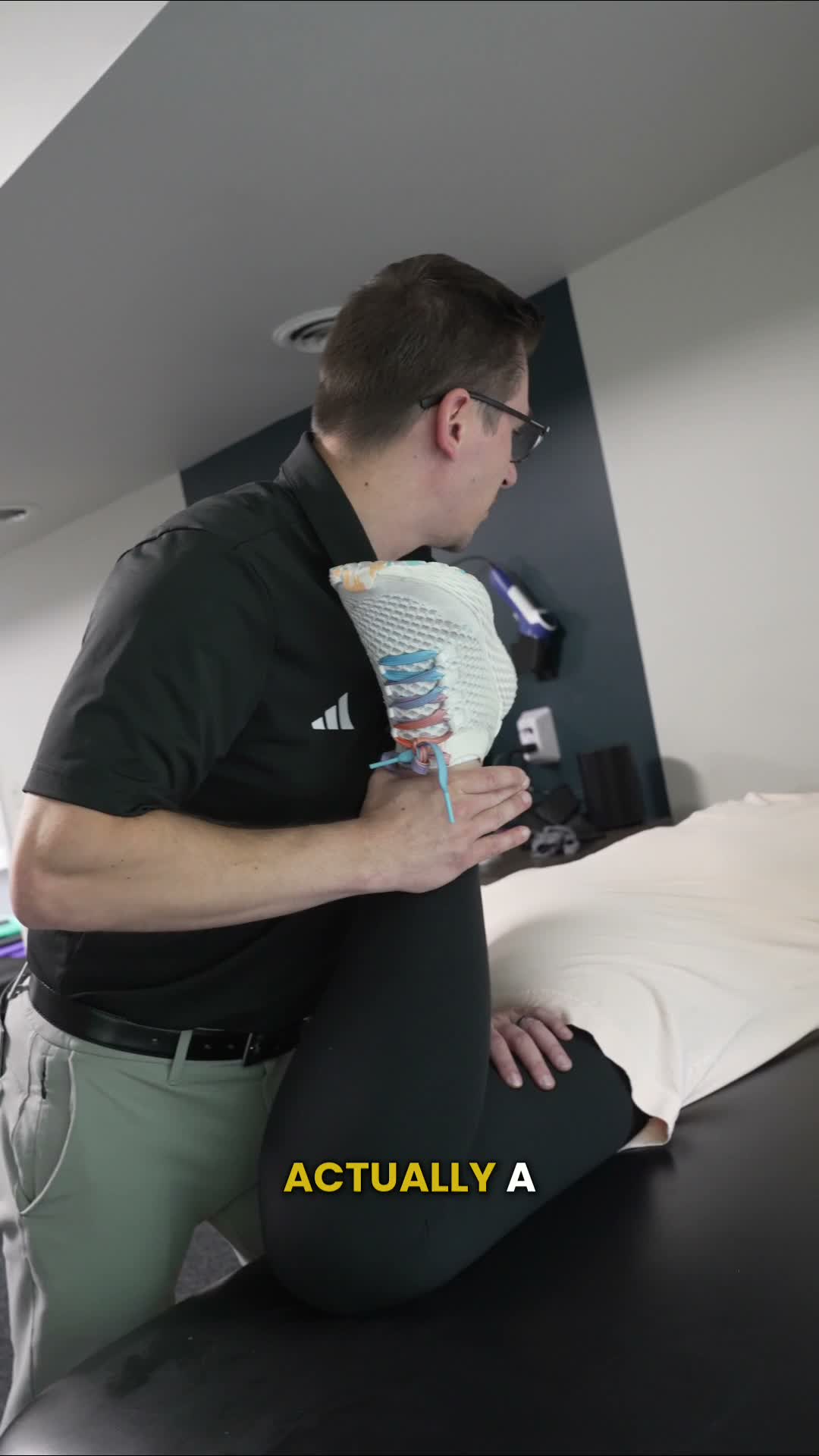
- Move to prone, right leg on the table and left leg down to the floor, so the hip is extended and the rectus femoris is on length. The rectus femoris is the only quadriceps muscle that crosses both the hip and the knee, which is why that position matters.
- Press the muscle belly and ask whether the knee feels any of it.
- Add a resisted kick into his hand to see how the muscle tolerates work.
- Treat the soft tissue, then retest the original movement.
Cycling came up in the conversation too, and it is worth repeating:
the biking in this instance is actually a great thing and it also keeps you in that really short like tuck position and depending on where your bike seat is, like it may actually be biasing more towards the quad
So the bike is not the villain. It is just one more input that favors the front of the leg, and in a leg that is already tightening, inputs add up. Our doctors come from a sports medicine background, which is largely a background in asking what the week of training is doing to the tissue, not only what the single exercise is doing.
Why does this matter more after surgery than before it?
Because the margin is smaller. A knee that has been protected for months does not have spare capacity for a tight quad on top of everything else.
What feels like the drop of a hat, you can recover tight, and then start to notice irritations you would otherwise never feel. That is the case for guided care through the loading phase rather than only in the first weeks after the operation. Soft tissue treatments and structured reloading are not a luxury at month seven, they are the part that keeps progress moving. For someone with a long runway, we can build length and strength gradually over months. For someone who needs a faster turnaround, we lean harder on hands on work and targeted loading to keep the schedule, within whatever the surgeon allows.
Key points
- The quadriceps pulls through the kneecap, so quad tension often reads as knee pain.
- Prone testing with the hip extended puts the rectus femoris on length and exposes it.
- If pressing the thigh reproduces the tension and the knee feels nothing, the muscle is the source.
- Protected range of motion early in recovery is why tightness appears later.
- Carly reported almost immediate relief after treatment. That is her account of her own recovery.
Frequently asked questions
Why does my knee hurt when I squat months after surgery?
Often because the thigh muscles have shortened during a protected recovery and are loading the kneecap more than they used to. It can also be the joint itself, which is why it is worth testing both rather than assuming. Any new or worsening symptom should also be reported to your surgeon.
What is the rectus femoris and why does it get tested first?
It is the quadriceps muscle that crosses the hip and the knee. Because it spans both joints, it gets short when a hip sits in flexion a lot, from sitting, from cycling, from months of a protected gait, and it then pulls on the kneecap.
Can I keep cycling while my quad is tight?
Usually yes, and cycling is a useful way to keep a knee moving. Just be aware that the seated, tucked position and your seat height can bias the work toward the quad, so balance it with work that lengthens the front of the hip and loads the back of the leg.
How long does recovery from a tibial tuberosity osteotomy take?
That depends on the surgery, whether cartilage grafts were involved, and your surgeon’s protocol. Carly was seven months out when she was back under a barbell, and that timeline was hers. Our role is assessment and rehabilitative care inside the plan your surgeon has set.
Sources
- American Academy of Orthopaedic Surgeons, OrthoInfo: Knee Exercises and Conditioning Program. https://orthoinfo.aaos.org/en/recovery/knee-conditioning-program/
If your knee has been sore under load since a procedure, bring it in and let us test which tissue is actually involved before you change your whole training plan. Our team in Hendersonville works these cases alongside your surgeon’s protocol. Book a visit with Active Sports Therapy and we will start with the assessment.
Active Sports Therapy · 123 Stadium Drive, Hendersonville, TN 37075 · 615-537-5520
Transcript of the video
And we know what this feels like right now. So this is actually like the perfect audit. So we’re gonna use this as our way to be able to test it after we do a lot of the soft tissue and everything, but I think we got to open table over here. So when do you feel any touches?
Yeah right around the top is at the top of the knee or back behind the knee and then if we change the position of the knee at all we go here and then go a different and go on to your belly where just the right leg is gonna stay on the table left leg is going to be down to the ground that lack of green. That’s so here. Is this knee or is this squad the stronger that that much more and so I mean the biking in this instance is actually a great thing and it also keeps you in that really short like tuck position and depending on where your bike seat is, like it may actually be biasing more towards the quad in that instance. Do you feel like when you buy is it more quad or is it more like gluten Hampshire?
We see this as like quads definitely taking on a lot though because we want this to be healed all the way to but right and when we and you’re so close, we’re like we’re like Yeah, but I think this just goes to show like how much tension is that the front of that leg and the big thing is you don’t feel anything in the knee here. This is only the muscle Belly of the Quad. So this gives us a lot of info like that. We need to be able to loosen that up as possible.
And so now I want you to be able to kick your way on out of this. So I want you to kick towards my hand.