
When an ankle still feels stiff months after a fracture, the joint itself is often not the reason. Many times the real limiter is tightness in the muscle and connective tissue around the ankle, or tension along the nerve that runs down the calf and shin, and the only way to know which one it is, is to test it directly rather than assume.
Why does dorsiflexion stay limited even after real improvement?
Dorsiflexion is the motion of bending the foot up toward the shin, and it is one of the first things that gets restricted after an ankle fracture. Andrea had already made real progress at an earlier visit, but her ankle still was not bending back as far as her uninjured side. Improvement and full motion are not the same thing, and the gap between them is where the useful questions start.
How do you tell whether it is the muscle, the nerve, the connective tissue, or the joint?
There is no way to see inside a moving joint from the outside, so the process has to be systematic. Rather than guess, the possibilities get worked through in order, and the ankle’s own response tells us which one is actually holding it back.
- Test the ankle’s active motion in two positions, once with the knee straight and once with the knee bent, since that separates a calf muscle limitation from a joint or ligament limitation.
- Spend time calming and loosening the tissue directly around the ankle joint, using repeated gentle stretch.
- Retest the same motion right away to see whether that work changed anything.
- If the retest shows no real change, treat the joint as ruled out for that day and shift attention to the muscle and nerve line instead.
What did testing actually show?
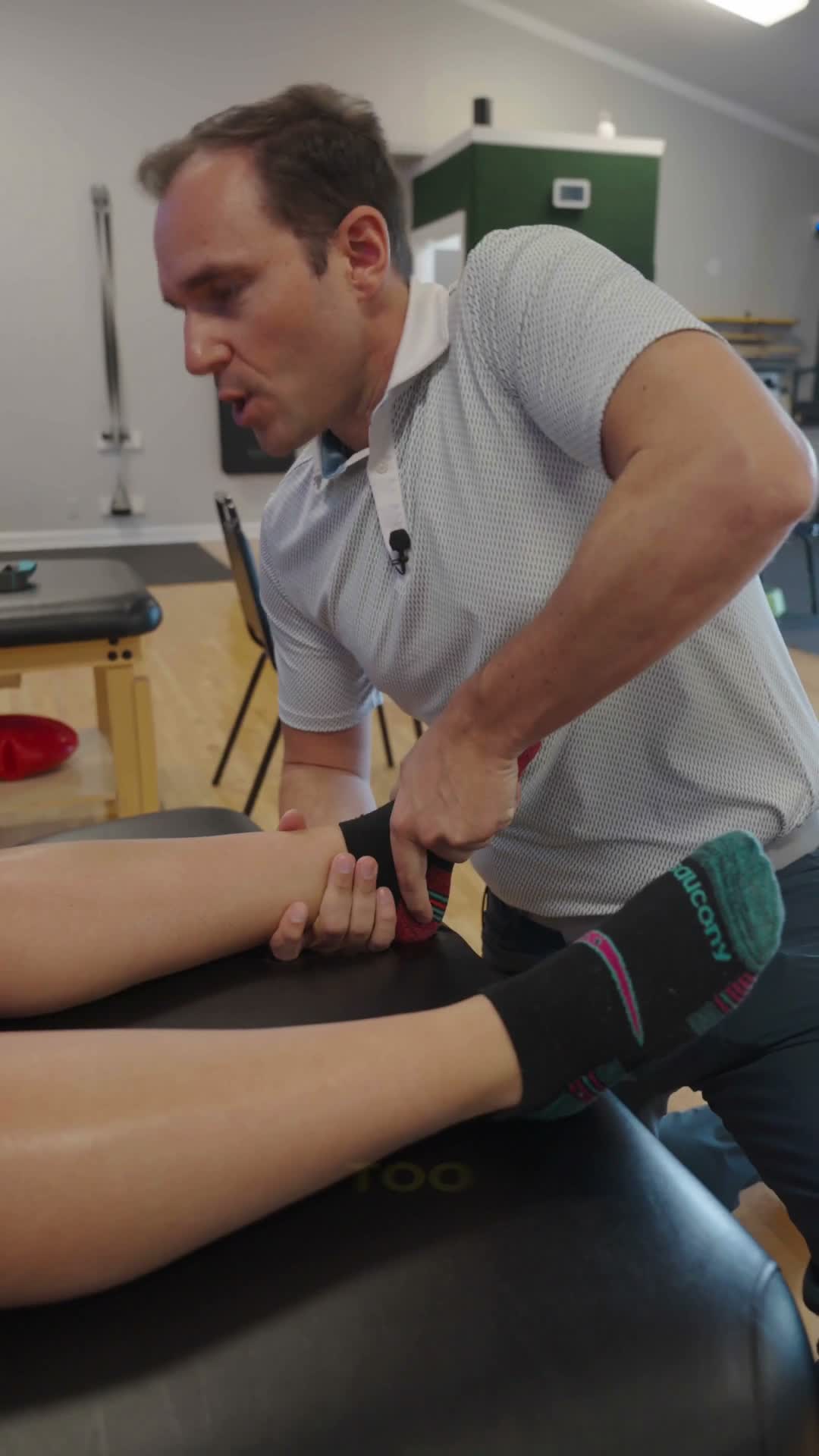
The body naturally braces itself while healing from a fracture, tightening the muscle and tissue around the injury for protection. That protective tension has to be worked back out before full motion can return. Andrea’s ankle was checked with the knee straight and again with the knee bent, and the difference between the two pointed away from the joint itself.
Make sure all the ligaments are super happy first.
That is the starting point before drawing any conclusion about the joint, calming the area down enough that whatever range shows up afterward is a fair test.
What happens once the joint is ruled out?
Once loosening and retesting the area around the joint did not add any more motion, and that held true across two visits in a row, the joint was no longer the working theory. For Andrea, the real limiter turned out to be the muscle and the nerve tension running down the back of the calf and the side of the shin. That is a different treatment target than the joint, and it changes where the time in the room actually goes.
Key points
- Improvement in range of motion after a fracture does not always mean the limitation is fully resolved.
- Testing the ankle with the knee straight versus bent helps separate a muscle problem from a joint problem.
- A limitation that does not change with direct work around the joint is a useful finding, not a dead end.
- For some people, the muscle and nerve tension around the calf and shin matter more than the joint itself.
- Test and retest keeps treatment aimed at what is actually limiting that person, rather than a routine applied to everyone.
Frequently asked questions
Why does my ankle still feel stiff months after a fracture?
Stiffness that lingers after a fracture often comes from the muscle and connective tissue that tightened up to protect the area while it was healing, not from the bone itself. It usually needs to be tested to find out exactly what is holding the joint back.
What does it mean if my ankle bends differently with my knee straight versus bent?
The calf muscle crosses both the knee and the ankle, so bending the knee takes tension off that muscle. If the ankle moves better with the knee bent, a tight calf muscle is a likely contributor rather than the ankle joint itself.
Can tight calf muscles really limit how far my ankle bends?
Yes. The calf muscle and the connective tissue around it can restrict how far the ankle bends upward even when the joint and ligaments are moving normally. That is why testing both matters before assuming the joint is the problem.
How long does it take to regain full ankle motion after a fracture?
This varies by person and by injury, and Andrea’s timeline is hers alone, not a general expectation. What can be said is that identifying the actual limiter, whether joint, muscle, or nerve tension, is what makes the rehab plan that follows worth doing.
Sources
- Lin CW, Donkers NA, Refshauge KM, et al. Rehabilitation for ankle fractures in adults. Cochrane Database Syst Rev. https://doi.org/10.1002/14651858.CD005595.pub3
- Weppler CH, Magnusson SP. Increasing muscle extensibility: a matter of increasing length or modifying sensation? Phys Ther. 2010. https://doi.org/10.2522/ptj.20090012
If your ankle has been slow to bend back after a fracture, a visit at Active Sports Therapy in Hendersonville can help work out whether the joint, the muscle, or the nerve tension is actually holding you back. Book a new patient visit and we will test it properly before we treat it.
Active Sports Therapy · 123 Stadium Drive, Hendersonville, TN 37075 · 615-537-5520
Transcript of the video
So a couple of the things here when we’re healing from a fracture like this the body naturally wants to create its own brace. And so it’ll naturally create its own tension and guarding, but we’ve got to get that back. And so when you’re missing about 15 degrees of that ankle motion, we need to do everything we can to get back and we need to protect and guard and relaxed at the same time your own muscle tone around it to allow us to get that full range back. So I like a lot of the movements you already started with today.
Those look really really good. I want to see if I can just mobilize this a little extra and get about half of that range of motion back. That would go a long way last week Dr. Joel did like I guess some stripping of the right here with the thumbs and stuff.
Yeah, and that helps significant. That’s amazing. That’s amazing. And that’s what we’re going to test too.
So the way I go about it is almost identical. Yeah, exactly. Make sure all the ligaments are super happy first. There’s this nerdy Effect called a disco elastic effective just means the more we work that the more it’s going to allow that Mobility to naturally want to come back and if it doesn’t then we’ve got to treat it muscular.
And so what I wanted to know right now is how much of that because you were already moving at some and it’s still wasn’t opening up how I hoped. So I’m wondering do I need to be more here or do I actually you’re exactly right need to be up here more and get those perennials to listen up. Okay, do that same move again for me girl pull that on up. So yeah, it actually it’s about the same so that doesn’t want to bend that much further.
So I think you’re right. We’re going to have to pay a little bit more attention there in the middle of the back of my calf. Yeah, and then down the side of the shin. Okay, cool.
Can you go on your tummy for me for me to work on that?


Leave a Reply